The review form arrives. It asks what you achieved this year, with examples.
You can remember the last six weeks in detail and the eight months before that as a haze with two or three landmarks in it. So you write about the last six weeks, plus whatever you can reconstruct, and the thing you are most proud of — the messy problem in March that you quietly fixed and nobody noticed — does not make the list, because you cannot recall it clearly enough to describe.
This happens to everyone every year, and the fix is about ninety seconds a week.
Why memory fails at exactly this
Not because your memory is bad. Because of what work looks like from inside.
The hard parts are invisible in hindsight. The thing that took three weeks of careful, frustrating effort gets compressed into "we shipped the migration" — a phrase with no evidence of difficulty in it. The version in your head is the outcome. The version worth writing about was the process.
Prevented problems leave no trace. The outage that did not happen, the bad decision you talked someone out of, the design flaw caught in review. These are frequently the highest-value things anyone does and they are literally unobservable: there is no artefact, no ticket, no launch. If you did not write it down, it did not happen.
Recency crowds everything else out. Whatever you did in the last month feels representative of the year, and it never is.
Other people's memory is worse than yours. Your manager has their own year to remember, plus five other people's. Assuming your contributions are visible to them by default is the most common and most expensive mistake in this whole area.
The two lines
Friday, or whenever the week ends for you. Two lines:
What I did. Not tasks — outcomes and the thing that made them hard. "Fixed the export timeout — the cause was the N+1 in the serialiser, not the DB, which took two days to find."
What that changed. For whom, and by how much if you can say. "Support had four tickets a week about this; it is now zero."
Ninety seconds. That is the entire practice.
The reason two lines beat a proper journal is that a proper journal does not get written. The bar has to be low enough to clear on the Friday when you are tired and want to leave, because those are the weeks it matters most. The hard weeks are where the good material is.
What to write that people leave out
Numbers, whenever one exists. Not because managers are impressed by metrics, but because a number is unforgettable and a claim is not. "Reduced the build from 14 minutes to 3" survives a year of hindsight. "Improved build times" does not survive the week.
The thing that made it hard. This is the difference between a work log and a task list. Anyone can list what shipped. Only you know that it needed three approaches, or a subtle bug, or a conversation with a team that did not want to have it.
Praise, verbatim, with the date. When someone says something appreciative in a message or a meeting, paste it in with the date and who said it. This feels awkward and it is the single highest-value thing in the whole log at review time, because it is evidence rather than self-assessment.
Things you were asked to do that were not your job. The scope you absorbed. This is how work quietly expands without recognition, and the log is the only record that it happened.
What you learned. Half for the review, half for you. A year of these is a surprisingly good picture of your own trajectory, and it is what you draw on when someone asks where you want to go next.
What went badly, and what you did about it. Not self-flagellation — the recovery. Reviews go better when you bring a failure with a lesson attached than when you appear to have had a perfect year, which nobody believes.
Reading it back
Three moments where the log earns its keep.
Before a one-to-one. Skim the last fortnight. Two minutes, and it turns "how's it going" into a specific conversation about specific things, which is what a 1:1 is supposed to be.
Before a review. This is the payoff. Instead of staring at a form trying to remember March, you read fifty entries and select. The work is choosing what to include, which is a much better problem than the one you had before.
Before an interview. A year of concrete examples with the difficulty preserved is exactly what behavioural questions ask for, and it is the reason people who keep logs interview better. They are not more accomplished; they can just remember what they did.
Where it goes
In your own notes, on your own machine, and this is not an incidental detail.
A work log kept in a company wiki or a work-issued account is a work log you lose access to the day you leave, which is precisely the day you need it most, for a CV, an interview, or a case for what you are worth. The same applies to anything in a Slack DM to yourself: it goes when the account goes.
It should also be somewhere private. An honest work log contains things you would not put in a shared document: what was frustrating, who was difficult, what you were unsure about. If it is somewhere your manager could read it, you will write a sanitised version, and the sanitised version is worth much less.
One note, growing downward, in a searchable collection you own. That is it, the same shape as a client note and for the same reason.
The honest version
This does not make you better at your job. It makes you able to describe your job, which is a different skill, and one that determines outcomes at exactly the moments that matter: promotions, reviews, interviews, and the conversation about whether you are underpaid.
The unfairness worth naming: people who keep logs do better at reviews than people who do not, at equal quality of work. That is a bad property of review processes rather than a good property of note-taking. Given that it is true, though, ninety seconds a week is a very cheap response.
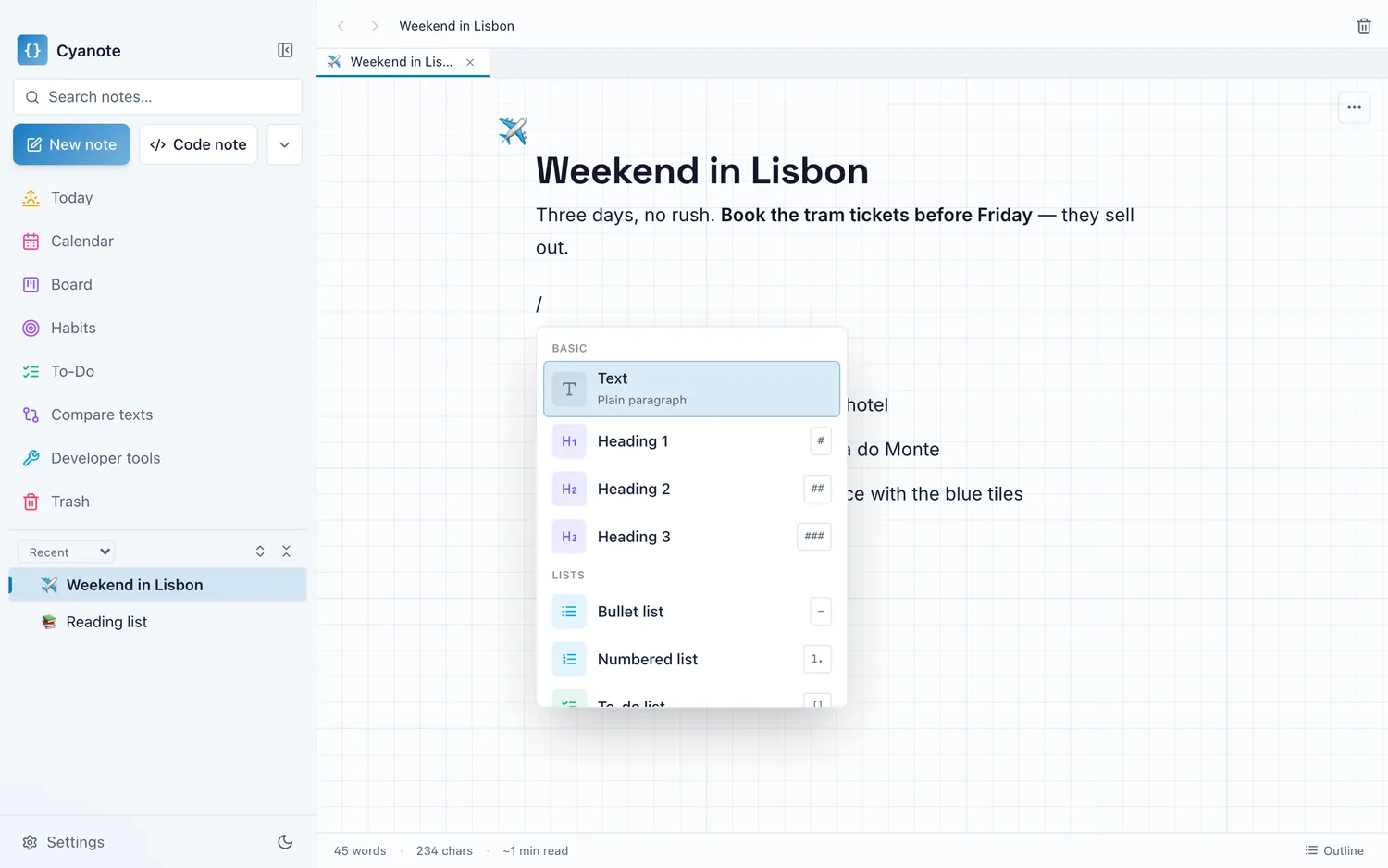
Cyanote is a reasonable place for it because the log stays yours: one SQLite database on your own computer, no account, nothing on a company server. ⇧⌘D (Ctrl+Shift+D on Windows) opens today's daily note if you would rather log as you go, full-text search finds "that thing about the migration" a year later, and any note can be locked with a password. There is a weekly review template in the / menu if you want the log to hang off something you already do, which is usually how habits survive.