The weekly review is the most recommended and least performed habit in personal productivity. Almost everyone who reads about it agrees it is a good idea. Almost nobody is still doing it six weeks later.
The reason is not discipline. It is that the version people are taught takes ninety minutes, requires you to be calm and unhurried, and asks you to face every loose end in your life at once. That is a wonderful thing to do occasionally and an impossible thing to do weekly.
What follows is the short version. Twenty minutes, four passes, a timer running the whole way. It is deliberately less thorough than the full ritual, and it is the one that survives contact with an ordinary Friday.
Why twenty minutes is the point
Two things go wrong with the long review.
It gets scheduled at a time when you are tired, because ninety minutes only fits at the end of the week, which is when you have least left. And it is open-ended, so it expands: you start reviewing tasks and finish reorganising your entire folder structure at 7pm on a Friday, feeling productive and having decided nothing.
A timer fixes both. Twenty minutes fits in the gap before a meeting. And a hard stop forces the review to do the thing it is for — deciding — rather than the thing that feels like it — tidying.
The bar is not "my system is perfect". The bar is "I know what is true and I know what I am doing on Monday."
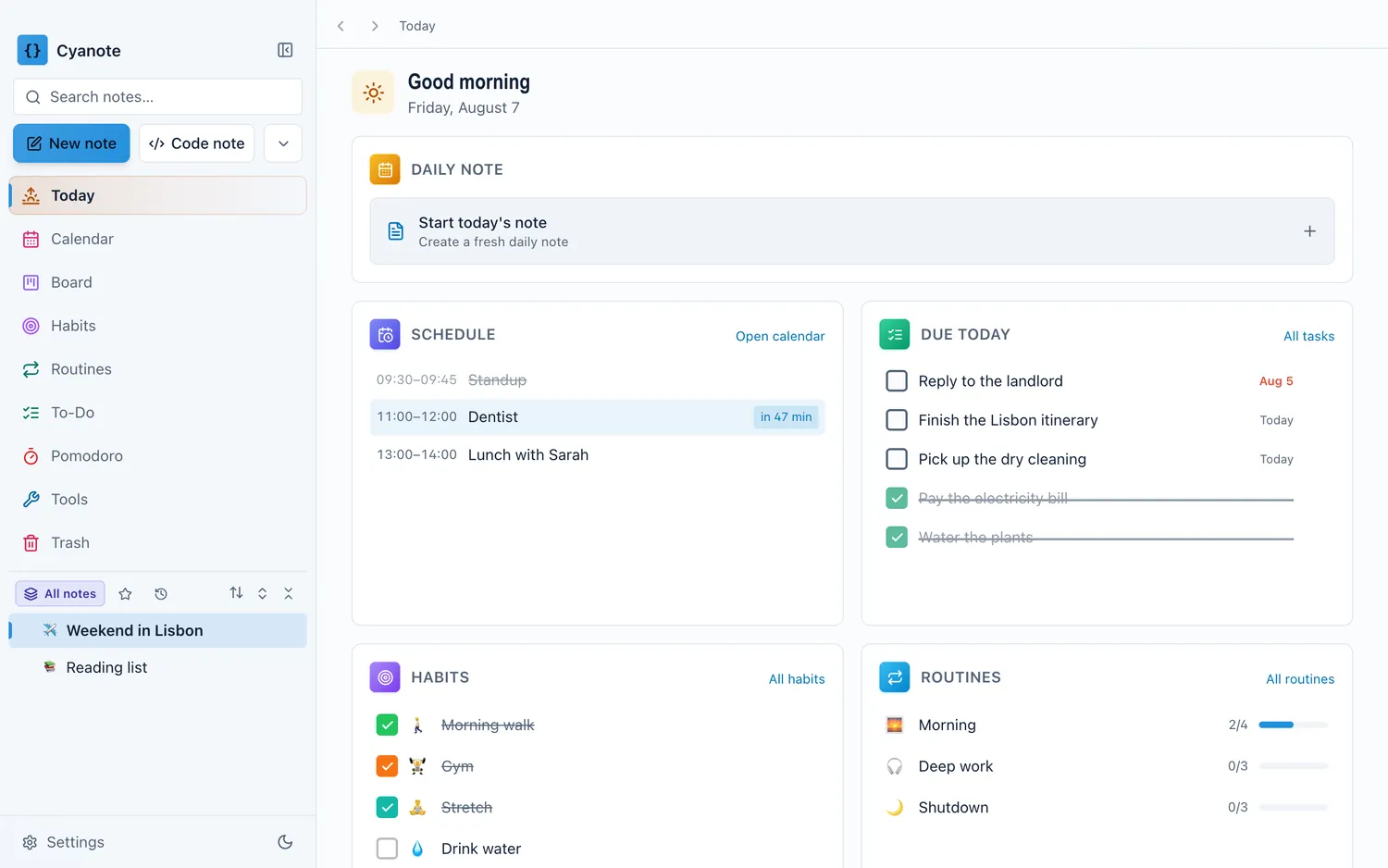
The four passes
Set a timer for each one. When it goes off, move on even if you are not finished, because unfinished is the normal state and the next review will catch it.
1. Clear — 5 minutes
Empty every place things land, without doing any of the work you find.
- Your inbox, down to whatever counts as empty for you. Reply only to anything under two minutes; everything else becomes a task and gets archived.
- The notes app you scribble into during meetings. Every scrap either becomes a task, gets filed into a real note, or gets deleted. Most of them get deleted, and that is the point.
- Physical: the pile on the desk, the receipts in your bag, the notebook.
- Your camera roll, if you photograph whiteboards and posters. Half a weekly review's worth of loose ends lives there.
The rule that makes this pass work: capture, do not act. The moment you start actually doing one of the things you find, the five minutes are gone and you have reviewed nothing. Write it down. Move on.
2. Read — 5 minutes
Now look at the week that just happened, honestly.
- Last week's calendar, day by day. Not for nostalgia, but for the meetings that produced a commitment you never wrote down. There is almost always one.
- Anything you marked done. Read it. This sounds sentimental and is not; it is calibration data for how much you can actually get through in a week, which is nearly always less than you plan for.
- Anything that was due and is not done. Do not fix it yet. Just notice it.
This is the pass people skip, and skipping it is why plans stay unrealistic. You cannot plan a week accurately if you never look at what happened to the last one.
3. Decide — 7 minutes
The longest pass, and the only one that matters. Go through everything outstanding and give each item one of four verdicts:
- Do it this week. It gets a date, not just a tick box. A task with no date is a wish.
- Do it later. It goes on a someday list you genuinely never look at except in this pass.
- Delegate it. Write down who and when you will chase.
- Drop it. Delete it, without ceremony.
The fourth verdict is the one that keeps the system alive. If nothing was dropped, you were not deciding, you were re-reading. Aim to delete something every single week. An item you have carried forward four weeks running is not a task; it is a decision you keep declining to make, and the honest move is either to schedule it now or to admit it is never happening.
4. Set — 3 minutes
Pick the shape of the week ahead.
- Name three outcomes for the week. Not thirty. Three. Written as things that will be true by Friday, not as activities: "the pricing page is live", not "work on pricing page".
- Put them in the calendar as actual blocks of time. An outcome without a slot is competing with everything else in your week and will lose.
- Look at what is already scheduled. If Wednesday has six hours of meetings, your three outcomes are not landing on Wednesday, and knowing that on Friday is worth more than discovering it on Wednesday morning.
Then stop. The timer went off. You are done.
The three mistakes
Doing the work during the review. It feels productive and it destroys the review. The review is for deciding what the work is. Keep a scratch list of the small things you are tempted to do, and do them after the timer.
Reviewing everything. Every project, every note, every reference folder. That is a quarterly job, not a weekly one. The weekly review only touches things that are live.
Missing one and quitting. You will miss weeks. A review done every second week is worth roughly ten times one done never. There is no streak to protect and nothing to catch up on. The next review just has a slightly fuller inbox.
The checklist, as one block
CLEAR (5 min)
  [ ] email inbox to zero-ish
  [ ] meeting notes / scratch pad emptied
  [ ] desk, bag, notebook
  [ ] camera roll
CAPTURE ONLY — do not do the work

READ (5 min)
  [ ] last week's calendar, day by day
  [ ] what got done
  [ ] what was due and did not

DECIDE (7 min)
  [ ] every open item: do / later / delegate / drop
  [ ] anything this-week gets a date
  [ ] delete at least one thing

SET (3 min)
  [ ] three outcomes for the week
  [ ] each one blocked in the calendar
  [ ] sanity-check against what is already booked
Copy it wherever you keep things. It does not matter where, as long as it is somewhere you will meet it again on Friday.
Doing it in Cyanote
I built this into the app I use, because a checklist you have to rebuild every week does not survive either.
Cyanote ships a Weekly review note template. It opens dated, with sections for Wins, Didn't get to, Lessons and Next week, so the Read and Set passes have somewhere to land. The Decide pass happens in the task list itself, where due dates and priorities live. And because tasks, calendar and notes are the same data rather than three synced copies, "what was due and did not get done" is something you look at rather than something you reconstruct.
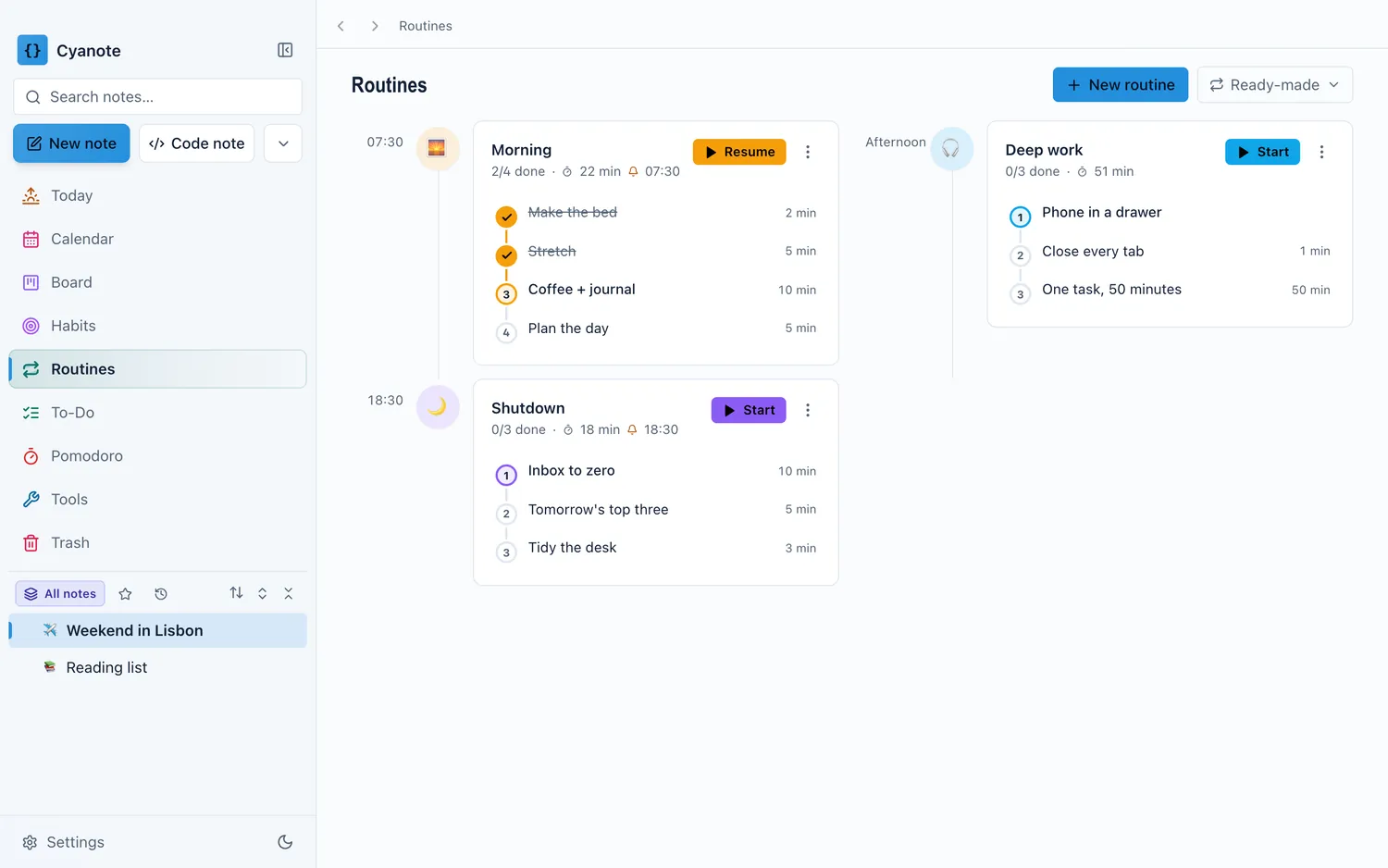
If you prefer the timer to run itself, the four passes also work as a routine: a timed checklist that moves you along, which is the version I use, because I cannot be trusted to leave the Decide pass after seven minutes on my own.
None of that is necessary. The method is the method; a pen and a Friday afternoon will do. But if you are already looking for one place to keep the week, Cyanote is a $7.99 one-time purchase that runs entirely on your own computer, Mac or Windows. I wrote about why it exists at all in I replaced five subscriptions with one $7.99 app.
Start with a bad one
Your first weekly review will be poor. The inbox will take fifteen minutes on its own, you will not get to the Set pass, and you will finish it feeling like it did not work.
Do it anyway, and then do the next one. By the third or fourth, Clear takes four minutes because there is less to clear, Read is quick because you remember the week, and the whole thing lands inside twenty minutes with room to spare. The review gets shorter precisely because you keep doing it, which is a rare and pleasant property in a habit.