Two things are true in your first weeks at a new job, and both have a deadline.
You can ask anything. Nobody expects you to know what the acronym means, why the deploy works that way, or who actually decides. That licence lasts about six weeks and then quietly expires, after which asking becomes a small admission.
And you can see the place clearly. You notice what is confusing, what is duplicated, what everybody works around. Within three months you will have stopped noticing, because you will have adapted. That is what adaptation is. The observations are not preserved by memory; they are overwritten by competence.
Both of those are worth capturing while they are available.
The four notes to start on day one
The glossary. Every acronym, product name, internal term, system name and shorthand, with what it means and who to ask. This will be the most-used note of your first two months and by far the highest return on effort. Nobody hands you this document because everybody already knows the words.
The map of people. Who does what, who reports where, who actually decides as opposed to who is nominally responsible, who to ask about which system, and one personal detail so you remember them as a person. Update it after every meeting where you learn something. The org chart is not this note.
The confusion log. Every time something does not make sense, one line. Not to complain, but to preserve. This is the note with the expiry date on it, and it is the source of nearly everything useful you will contribute in month four, because by then you will understand the system well enough to fix the things you can no longer see.
The work log. Start on day one. Your first review will cover this period, and the early weeks are the hardest to reconstruct because everything was undifferentiated. Two lines a week, starting now.
How to take notes in the first weeks
You will be shown a great deal very fast, and most of it will not stick.
Write during, tidy after. During a walkthrough, capture terms, names and things you did not follow. Do not try to structure it; you do not yet know what the structure is. Ten minutes afterwards, move things into the four notes.
Write down what you did not understand, specifically. "I did not follow why the staging deploy needs the manual step" is a question you can ask later. "Deploy: confusing" is not.
Ask for the reason, and record it. The most valuable thing you can learn in the first month is not how something works but why it is that way. Systems have history, and the history explains the parts that look wrong. Write down the answer with the name of who gave it. You will need to cite it later, and people misremember.
Record what you were told, not what you concluded. Early conclusions are usually wrong, because you are missing context. What someone actually said is durable; your interpretation of it at week two is not.
The thing to write in week six
Sit down for twenty minutes and write everything you found confusing, before you stop finding it confusing.
This document is genuinely valuable and almost nobody produces it. It is the onboarding feedback the company cannot generate internally, because everyone who could write it has forgotten. It is also the seed of your first real contribution: the fixes that make you look observant in month four all come from this list.
Write it for yourself first. Whether you share it is a separate decision, and if you do, share it as observations rather than criticism, from someone who wants the place to be easier rather than someone auditing it.
What not to write
Some restraint is warranted, because notes about work are notes about people.
Not judgements about people, in anything shared. "X seems disorganised" at week three is an opinion formed from almost no information, and it can outlive both the impression and your reason for forming it. Keep the map factual: what they do, what they know, how to reach them.
Not confidential material you have no reason to hold. Salary information you saw by accident, personal details from an HR conversation, anything covered by a policy you have just agreed to. If you would not want to explain why you have it, do not keep a copy.
Not on a machine you do not control, if it is personal. Your work log, your confusion log and your career notes are yours. The glossary and the systems documentation belong in the company's wiki, where they help everyone and where you are not the only copy.
That split matters, and it is worth deciding deliberately in week one rather than discovering at the exit interview: shared knowledge goes in the shared place; your own record of your own work goes somewhere that leaves with you.
Month three: the review
Reread all four notes.
The glossary tells you how much you have learned, which is a genuine and underrated morale boost around the point where the initial adrenaline has worn off and you feel slower than you expected.
The people map is now accurate enough to be useful and should be kept updated indefinitely. It is the note you will still be using in year three.
The confusion log is the one to act on. Go through it and sort into three: things that confused you and now make sense, things that are genuinely broken and fixable, and things that are broken and not yours to fix. The middle column is your first real project.
The work log you keep forever.
The honest version
This is more writing than most people do when starting a job, and the case for it rests on one asymmetry: the first six weeks generate information you can never get back, at a moment when you have more spare attention than you will have again.
If you only do one of the four, do the glossary. It pays for itself within a fortnight and it is the one you will actually maintain.
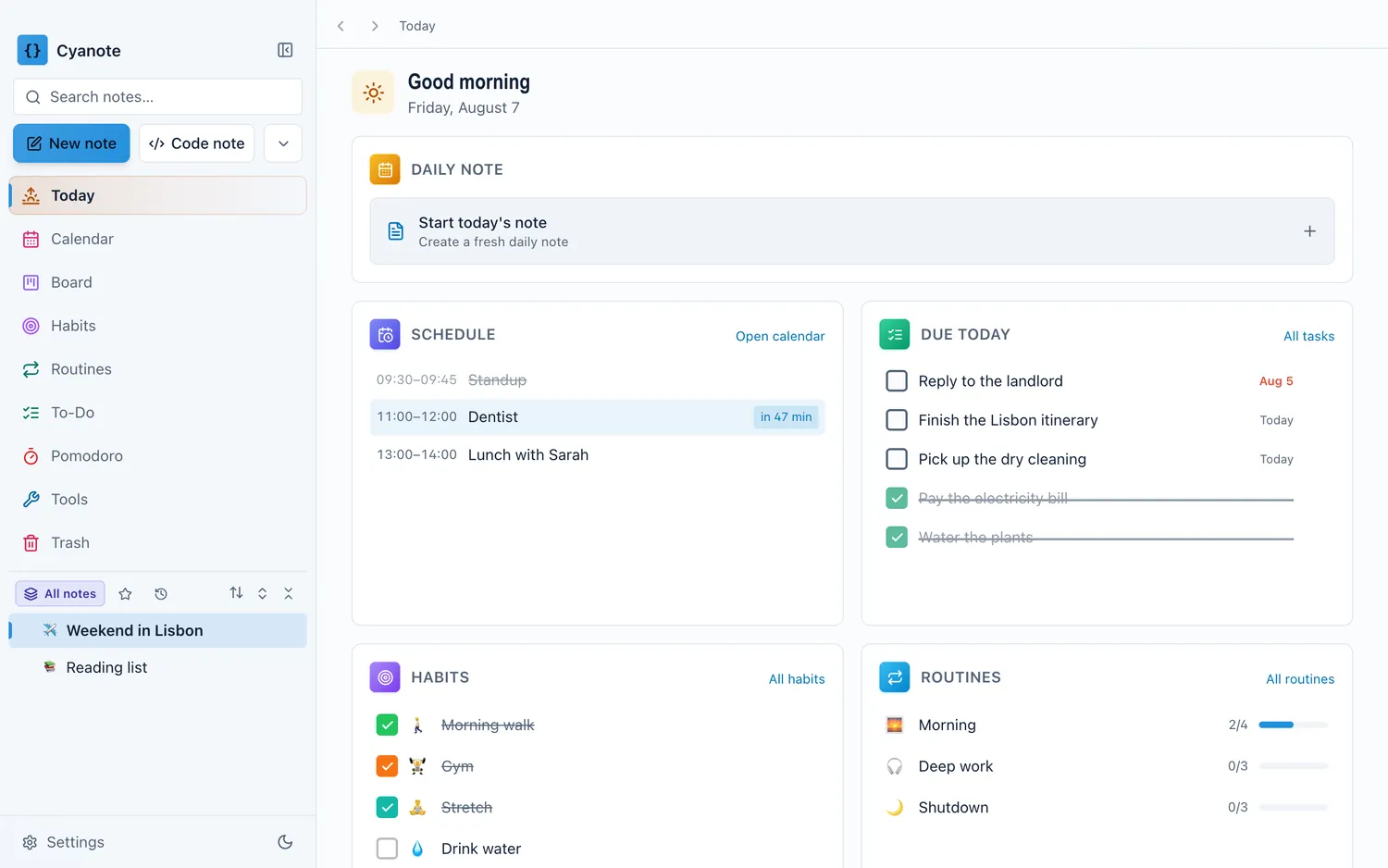
Cyanote suits this well because the personal half stays personal: one local database on your own computer, no account, nothing on a company server, and it leaves with you when the laptop does not. Notes nest into sub-pages so the people map can hold a page each, [[ links connect a meeting note to the person it was with, and full-text search finds the acronym you wrote down in week two and have not thought about since. There are meeting, standup and 1:1 templates in the / menu for the parts that recur.