Somewhere in your system is a list of things you might do one day. Learn the instrument. Write the thing. Fix the cupboard. Read the book. Start the side project.
You have not opened it in eleven months, and when you do it produces a specific unpleasant feeling — a wall of intentions you have not acted on, arranged as evidence. So you close it. And because you closed it, the next genuinely good idea also goes in and is also never seen, which means the list has stopped being a system and become a place where ideas go to be filed away from you.
The mechanism it was supposed to provide is real. It just needs one thing nobody does.
What the list is actually for
Two jobs, both legitimate.
Getting it out of your head. An unrecorded intention costs you background attention indefinitely — it keeps surfacing, because part of you does not trust that it will be remembered. Writing it down genuinely stops that, and that alone justifies the list even if nothing on it is ever done.
Being there when the conditions change. You have three free weeks, or a budget, or you finally moved house. The list is where you look, and the value is that six months ago you knew something about what you wanted that you have since forgotten.
Note what is not on that list of jobs: making you do things. A someday list is not a to-do list with a longer horizon. It is a holding pen, and the moment you treat it as commitments you have created a debt you cannot service.
Why it becomes a graveyard
Nothing is ever removed. Items only go in. After two years there are 200, and no list of 200 things is readable. You scan the first twelve and close it.
It mixes categories. "Learn Portuguese", "buy a lamp" and "write a novel" require completely different amounts of life, and interleaving them makes the whole list feel equally unachievable.
Every item is a small reproach. Because it is written as a commitment — "learn Portuguese" — rather than as a note about a desire. The wording turns a preference into an unpaid obligation, 200 times.
There is no moment where it gets looked at. So it is only ever read accidentally, which is always the wrong emotional moment for a list like this.
The fix: deletion is the feature
The list needs an eviction rule, and it has to be a rule rather than a judgement, because judged item by item nothing is ever deletable.
Every item gets a date when it was added. Almost free, and it is the whole mechanism, because age is the signal.
At review, anything over a year old gets one question: would I start this in the next three months? Not "do I still like the idea" — every idea on the list is a nice idea, that is why it is there. Would you start it. If no, delete it.
Deleting does not mean you have given up. This is the part that makes it psychologically possible. If the desire is real, it will come back. That is what a real desire does. If it never comes back, it was a passing interest, and passing interests are not failures. They are how people find out what they like.
A list that shrinks is a list you will keep reading. That is the entire trade.
Sorting by size, not by theme
Categories that work, because they map to what has to be true for you to start:
An afternoon. Fix the cupboard, cancel the thing, get the frame made. These do not belong on a someday list at all. They belong on your actual to-do list with a date on them, and moving them off is usually a third of the list gone in one pass.
A weekend. Small projects. These are the ones the list is genuinely for, because they need a free weekend to coincide with the inclination, and that coincidence is exactly what a list catches.
A season. Learn the thing, write the thing. You can run one of these at a time and not more. If four are marked active, none are.
A different life. Move country, change career, buy the boat. These are worth keeping and they are not projects. They are preferences, and reading them once a year is genuinely informative about where you are heading.
The last category is the one to keep in a note rather than a task list. Written as prose — "I keep coming back to wanting to live somewhere with fewer people in it" — it stops being an unpaid obligation and becomes what it actually is: a thing you know about yourself.
The review that makes it work
Once a quarter. Twenty minutes. Not more often. Nothing changes in a month, and a list reviewed monthly becomes a monthly reminder of what you have not done.
Delete by the rule first, before reading properly. Get the list down to something readable, and do it mechanically so you are not negotiating with each item.
Move afternoon-sized things to the actual to-do list, with dates.
Pick one. One thing that becomes real this quarter, with a first step that is a dated task. One, because two is none.
Read the rest without deciding anything. That is the part that does the work you cannot force — it puts the ideas back in circulation, and one of them will surface next month while you are doing something else.
Attaching this to something you already do is what makes it happen at all. A quarterly review that hangs off a weekly review you actually keep survives; one that requires remembering a new ritual does not.
The honest version
You will do maybe five percent of what goes on that list, and a bigger list does not raise the number. Capacity is the constraint, not memory.
Which means the list's real job is not storage. It is being small enough to read, so the ideas are actually in circulation rather than filed away from you. Every deletion makes the remaining items more likely to happen, and that is a genuinely counterintuitive property worth internalising.
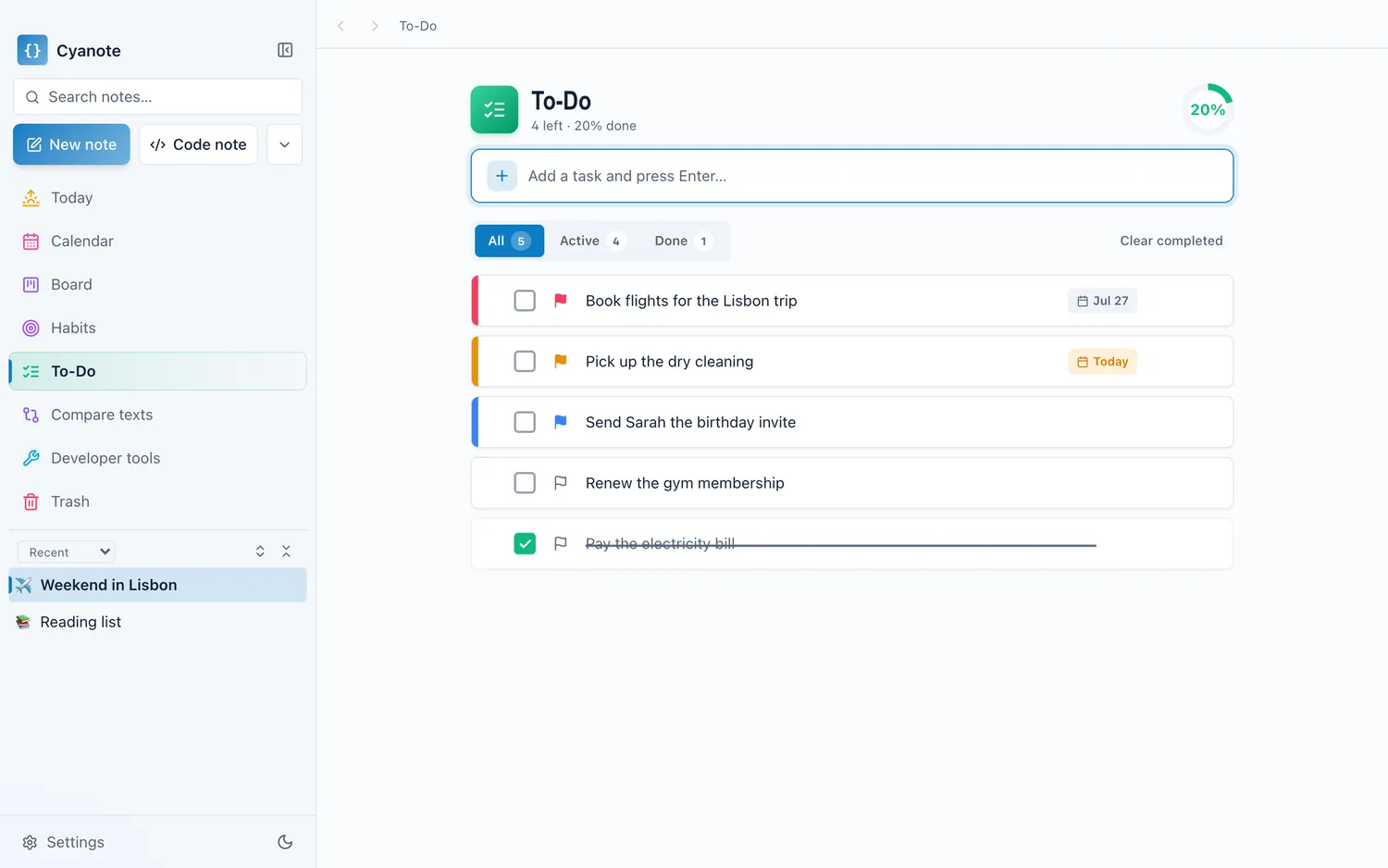
Cyanote holds both halves in one place: the afternoon and weekend items as tasks with dates lifted out of the sentence you typed, and the seasons and the different-life material as notes, in prose, where they read as things you know about yourself rather than as debts. A board view gives the quarterly sort a shape, and full-text search finds the idea you had in 2024 and half-remember. It is one local database on your own computer, which for a list of everything you privately want is not an incidental detail.