Reorganising your notes is the most satisfying way to avoid writing any. It produces visible progress, it feels like care, and at the end of an afternoon of it you have exactly as many ideas as you started with, arranged more neatly.
That is worth saying up front, because most advice about organising notes assumes the goal is a tidy structure. It isn't. The goal is that in eight months, when you half-remember something, you can find it in under a minute. Every system below should be judged against that and nothing else.
There are three tools, and they are not competing versions of the same thing.
Folders: one home, one decision
A folder puts each note in exactly one place. That constraint is the entire feature. It is what makes a folder tree navigable, and it is what makes it painful.
Folders are genuinely good when a note belongs to something with a beginning and an end. A client, a trip, a house move, a course. The project starts, notes accumulate, the project finishes and the whole folder goes quiet. You will never wonder whether the plumber's quote belongs under "House". That is not a hard call.
Folders go wrong the moment a note honestly belongs in two places. A note about pricing your freelance work is both "Freelance" and "Money". You will file it in one, look for it in the other, and conclude the system is broken. It isn't; you asked a filing cabinet to hold something in two drawers.
The failure mode to watch for: a folder tree more than about three levels deep. Deep trees are a sign you are encoding facets — status, topic, year — as nesting, and facets are what tags are for.
Tags: many labels, one note
Tags invert the constraint. A note can carry as many as you like, so the two-places problem goes away.
The cost is that tags require you to be consistent with yourself over years, which is a genuinely hard thing to be. You tag something #finance in March and #money in September. Neither is wrong, and now half your notes are invisible to each search. Tag lists sprawl, and a tag list with two hundred entries is not an index, it is a second problem.
Tags work best when you keep the vocabulary small enough to hold in your head, somewhere under about fifteen. That usually means using them for one axis and one only. Status is the classic good use: #waiting, #someday, #reference. These are things a note is right now, they change over time, and there are only a few of them.
Using tags for topic is where people drown, because topics are unbounded. Every new subject you encounter is a candidate tag, and nothing ever tells you to stop.
Is search on its own enough?
Full-text search across everything you have ever written is the reason all of this is less important than it used to be. If you can type a distinctive phrase and land on the note, the folder it sits in stops mattering very much.
This genuinely changes the correct answer. Most of the elaborate systems people inherit were designed for tools where finding things was expensive. When retrieval is nearly free, the effort belongs at the moment of writing, not the moment of filing.
The limit of search is precise: it only finds words you actually wrote. If you search for "the thing the accountant said about the car" and the note says "vehicle expense, business use proportion", you will not find it. Search does not know what you meant.
There is also a stubborn human limit, and it is worth knowing before you throw your folders away. Researchers studying how people retrieve their own files have found repeatedly that, even when the search engine is good, people navigate to a known location first and search only as a last resort, and that when they do search, it takes them longer and fails more often. One neuroimaging study found that moving through a folder tree recruits the same brain structures used for navigating physical space, which is a fair explanation for why the habit outlives every improvement to search. So the honest version of this section is not "search replaced folders". It is that search removed the penalty for filing badly, while most people still reach for a place before they reach for a query.
Which points at the habit that does the most in this entire post, and it has nothing to do with structure.
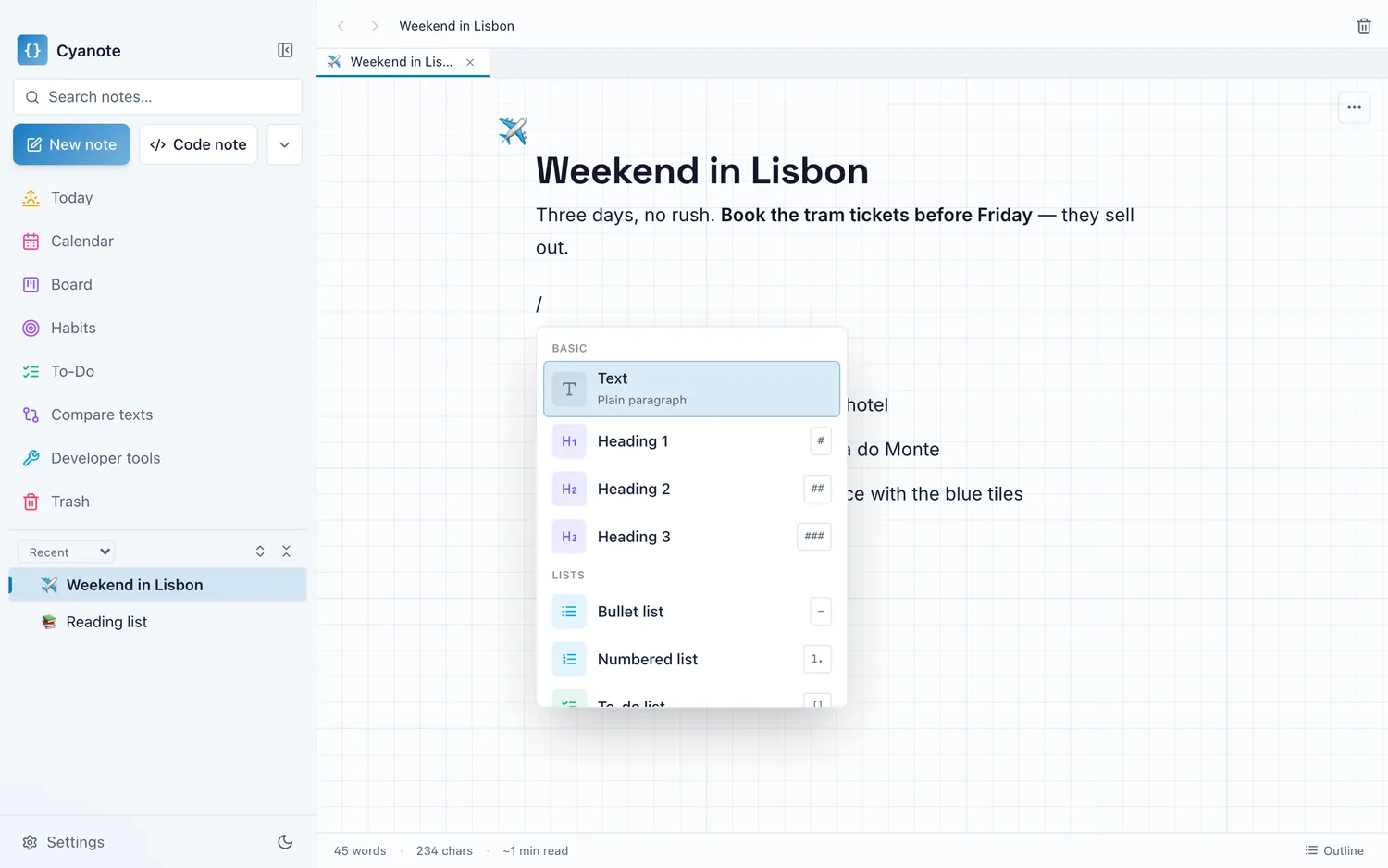
The reason this blog's app leads with full-text search across every note rather than a folder tree is the same one: Cyanote assumes you will search, and treats folders as somewhere to put things afterwards.
What should you name a note?
The title is the one piece of metadata you fill in every single time, without deciding to. It is free. And most people waste it.
A note called Meeting is unfindable. Notes is worse. Untitled 47 is a small future tax you have chosen to pay.
Write the title as the sentence you would say to someone describing the note eight months from now. Not "Insurance" but "Why we switched car insurers and what it cost". Not "Ideas" but "Ideas for the workshop, from the walk in February". The second version contains the distinctive words you will actually type into a search box, because they are the words your memory kept.
This one change does more for retrieval than any folder structure, and it costs four extra seconds.
Links: the option people forget
The fourth tool is pointing one note at another. Where folders and tags describe categories, links describe relationships: this note came out of that meeting, this decision replaced that one.
Links are strongest for material that grows over time: an ongoing topic where notes refer back to each other, a decision log, anything where the connection between two notes is more informative than the category both sit in. They are overkill for a receipt.
A word of caution, since this is where note-taking gets faddish: an elaborate web of links is the most enjoyable form of the procrastination this post opened with. Link things when the connection is real and you would want to follow it. Do not link things to build a graph.
A setup that survives contact with real life
If you want something concrete:
- Search is the primary way you find things. Assume it, and write titles accordingly.
- A shallow folder for each live project, plus one for reference and one for archive. Two levels. When a project ends, move the folder to archive rather than tidying it.
- Tags for status only — the handful of states a note can be in. Not topics.
- Links where a relationship genuinely exists, and nowhere else.
- Back the archive up. An archive you cannot recover is not an archive; the backup side of this takes an afternoon once.
- Archive rather than delete. Search makes an archive cheap; a note you cannot find is already effectively deleted, and one you deleted is not coming back.
The test I hold any of this to is not whether it looks organised. It is whether, in eight months, you find the thing. Everything that does not serve that is a hobby, and it is fine to have hobbies. Just don't confuse one with a system.