Think of a decision you made two years ago that turned out well. Now try to recall what you expected at the time, not the outcome, the expectation. Specifically: what you thought the odds were, and what you thought could go wrong.
You cannot. Nobody can. What you have instead is a story assembled after the fact, in which you knew roughly what would happen, and the surprises have been quietly written out because they no longer fit.
This is not a memory defect you can train away. It is how memory works, and it means that without writing something down, you cannot learn from your own decisions. You only get to learn from the versions of them you have already rewritten.
Why experience does not automatically improve judgement
You need three things for a decision to teach you anything: what you predicted, what happened, and a comparison.
The middle one is easy. Outcomes are loud. The first is where it collapses, because by the time the outcome arrives you have already updated, and the updated belief feels like the original one. There is nothing to compare against.
The consequence shows up as two errors, both common in confident, experienced people. Outcomes get credited to reasoning that was not there — a good result from a bad decision that got lucky, remembered as good judgement. And bad outcomes get blamed on things nobody could have known, when the risk was in fact identified at the time and dismissed.
A decision journal fixes exactly one thing: it preserves the prediction so a comparison is possible. That is the whole mechanism, and it is why five lines beat any amount of reflection.
The five lines
Write these before you know how it turned out. That is the only rule that matters.
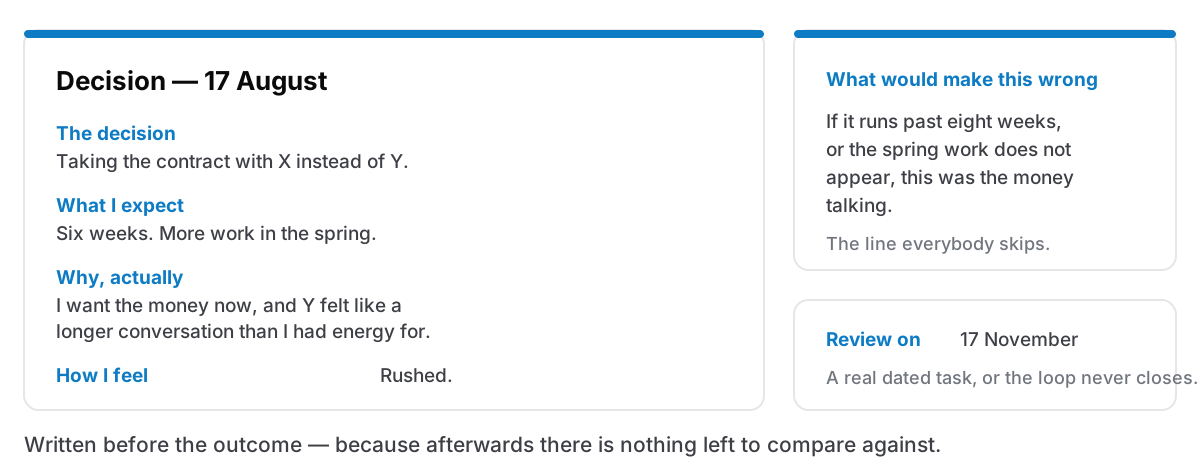
The decision. One sentence, plainly. "Taking the contract with X instead of Y."
What I expect to happen. Concrete enough to be wrong. Not "it should go well" — "I expect this to take six weeks and lead to more work in the spring."
Why — the two or three actual reasons. Not the justification you would give someone else. The reasons that are doing the work, including the unflattering ones. "Mostly because I want the money now and Y felt like a longer conversation."
What would make this wrong. The single most valuable line, and the one everybody skips. Name the thing that, if it happened, would mean this was a mistake. It forces you to hold a version of the world where you are wrong, at the one moment when you can still see it.
How I feel. Rushed, excited, cornered, relieved. State is a strong predictor of decision quality, and it is completely invisible in hindsight. You will never remember that you decided this while exhausted, but you will be able to read it.
Five lines. Two minutes. The whole method.
What to log, and what to leave alone
Not everything. A journal of every decision is a journal nobody keeps.
Worth logging: anything you would be annoyed to get wrong and will find out about within a year or two. Hiring someone. Taking or leaving a job. A significant purchase. Choosing a technology you will live with. Ending or continuing something. If you notice yourself arguing internally about a decision, that argument is the signal.
Not worth logging: reversible decisions, small ones, and anything whose outcome you will never learn. If there is no feedback, there is nothing to compare, and the entry is journalling rather than calibration.
Most people end up with somewhere between one and four entries a month. If you have twenty, you are logging preferences rather than decisions.
The review is half the value
An entry nobody rereads is a diary. The comparison is where the learning lives.
Set a date when you write it. "Check this in three months." Put it on the calendar or in the task list as a real dated item, because you will not spontaneously remember. This is the single most common failure of decision journals: the entries are excellent and nobody ever opens them again.
When the date arrives, read the entry before assessing anything. Read your prediction first. Then compare. The order matters enormously. Read the outcome first and you will find your prediction was basically right, because that is what minds do.
Score the decision, not the outcome. This is the discipline that makes the whole practice worth doing. A good decision can have a bad outcome; a bad one can get lucky. If you only grade outcomes you will learn to be lucky, which is not a skill.
Look for patterns across entries, not lessons within one. One decision teaches you almost nothing. Ten teach you a great deal: that you consistently underestimate how long things take, that you decide badly when cornered, that your worst calls are the ones you made quickly to end a conversation. Those patterns are the actual product, and they only appear in aggregate.
Where it should live
In your ordinary notes, not a special app.
A decision journal in a dedicated tool becomes a thing you visit; in the same collection as everything else, it is a thing you pass. That matters, because the moment of writing is always the same: right after the decision, when you are moving on to the next thing and any friction means it does not get written.
Two mechanics make it work in practice. The review date needs to become a real task with a date on it, or the loop never closes, which is easiest if writing a dated task takes one sentence. And entries want to be linkable to the thing they are about, so a decision about a client shows up next to that client's notes without being filed there twice. That is the small linking habit doing useful work rather than decorative work.
The honest version
This is a slow practice with no visible payoff for a year. The first ten entries feel pointless, because there is nothing to compare them to yet, and most people stop somewhere around entry four.
It is also close to the only reliable method for improving judgement that does not require anyone else's involvement, and it costs two minutes a fortnight. The trade is heavily in your favour if you can survive the first year of it doing nothing.
Cyanote has a decision-journal template in the / menu: the five prompts above, in order, so an entry is a fill-in rather than a blank page. It sits in the same collection as the rest of your notes, searchable by any word in it, linkable to whatever it concerns, with a task carrying the review date. Everything lives in one SQLite database on your own computer: for a document that records what you actually thought and how you actually felt, that seems like the right place for it.