Anything you practise over years — an instrument, running, lifting, the garden, a craft, a language — has the same problem. Progress is slow enough to be invisible from inside it, and the things that explain your progress are forgotten within a fortnight.
There is an app for the numbers. There is rarely one for the part that matters.
What the tracking apps miss
Specialised apps are excellent at quantities. Sets, reps, distance, pace, minutes, watering schedules, streaks. That data is real and it is worth having.
What they do not hold is the sentence that explains it.
You had a bad run on Tuesday. The app records a slow pace. It does not record that you had slept badly, that it was unusually humid, that the shoes were new, or that your knee felt odd from about mile three. Six weeks later, when the knee is a problem, the app shows a graph with a dip in it and no information about what happened.
The number is the outcome. The note is the cause, and the cause is what you would want to know.
The four lines
After a session, four lines. Ninety seconds.
What I did. The quantities, if you are not already logging them elsewhere.
How it felt. One word is enough — heavy, easy, sharp, flat. This is the single most predictive line in any practice log and it is in none of the apps. Three "heavy" sessions in a row is information you will otherwise notice a month late.
What I noticed. The technical thing. The bar drifting forward, the passage where you always slow down, the third bed drying out faster than the others, the phrase you keep mispronouncing. This is the line that makes the log worth rereading, because it is what you were working on, in your words.
What to try next time. One thing. Which turns the log from a record into an instruction, and means the next session starts with a plan rather than with remembering what you were doing.
Four lines. Not a training diary, not a journal. Four lines.
What shows up over a year
The reason to keep it, and none of these are visible session by session.
The conditions that predict your good sessions. Almost everyone has two or three, and almost nobody knows what they are without a record. Sleep, time of day, what came before, whether you had eaten. When you can see it across fifty entries, it stops being folklore about yourself and becomes something you can arrange.
Injuries and problems have a prologue. Something almost always felt slightly off for weeks before it became a problem, and you almost always dismissed it. The log is the only place that early signal survives, and reading back from an injury to find three mentions of the same niggle is both useful and slightly chastening.
Plateaus are usually shorter than they feel. Being stuck is a feeling generated by comparison with last week. Reading what you wrote a year ago is the corrective, and it is frequently the difference between continuing and quitting.
What you keep trying and abandoning. The same "work on this next time" appearing eight times over a year means you are not actually working on it. That pattern is invisible without the record and obvious with it.
Numbers where they matter, prose where they matter
Worth being clear on the division, because logging everything is how logs get abandoned.
Numbers: the quantity, and anything you genuinely compare over time. Weight, distance, minutes, count. Use the specialised app if you have one. It will graph them better than any notes app.
Prose: everything that explains the numbers. It does not need to be structured, tagged or quantified. "Felt heavy, third set collapsed, probably the 5am start" is worth more than a mood rating out of ten, because the reason is in it.
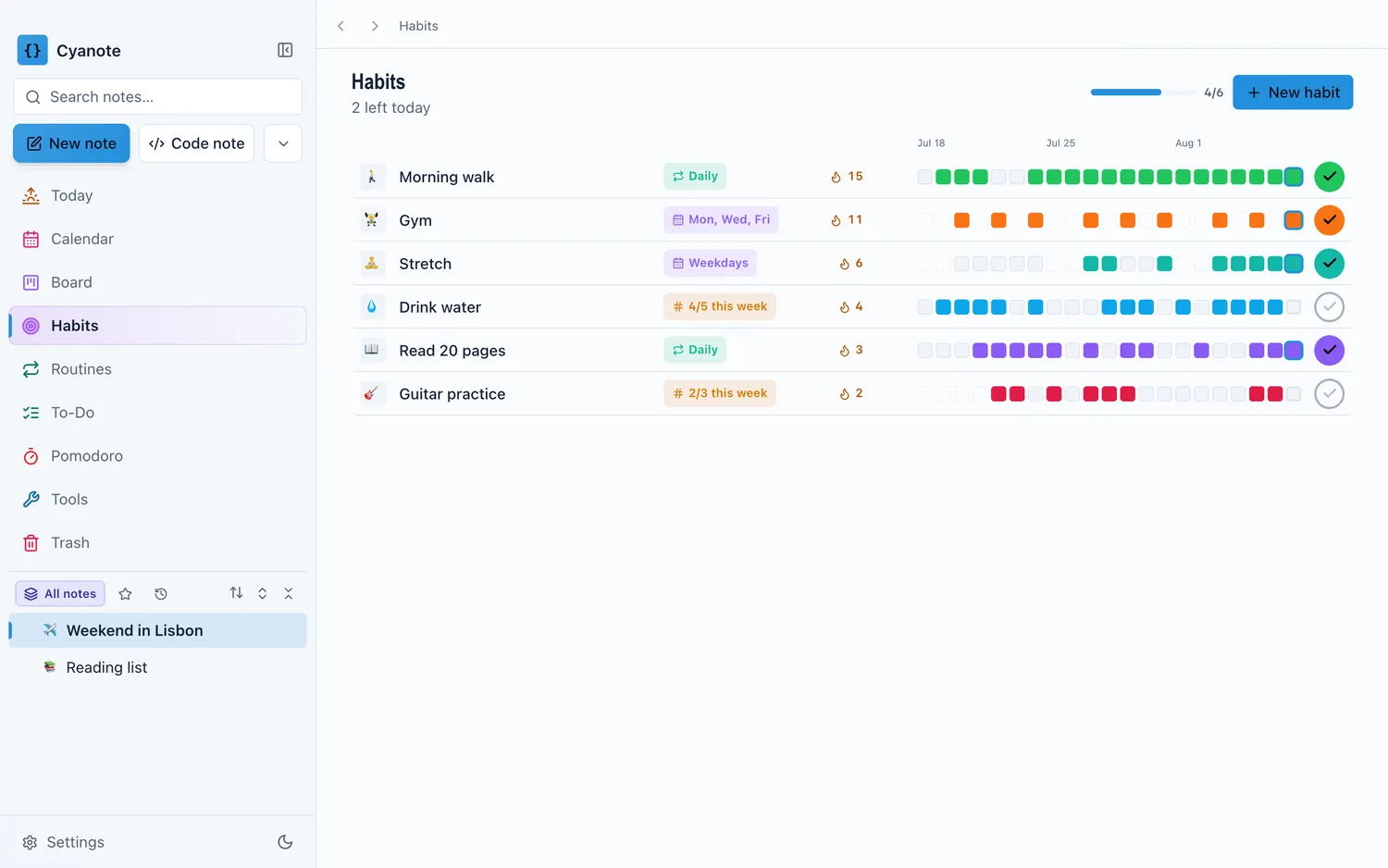
A grid for whether you turned up. A habit tracker's grid of days is the right shape for one specific question — consistency — and it is the one thing a prose log answers badly. Four weeks of squares shows a gap on the 3rd immediately.
Three formats, three jobs, and the mistake is asking one of them to do all three.
Where it should live
Somewhere you will still have in five years, which rules out most specialised apps.
This is the practical argument. A practice log is only valuable at a horizon of years — a year of running notes or three years of a garden is where the patterns are — and specialised tracking apps have an unusually high failure rate over that period. They get acquired, they move to subscriptions, they discontinue, they lose your history in a migration. Every long-term hobbyist has lost a log this way.
Prose in a general notes app that exports to a readable file is the arrangement most likely to survive to the point where it is worth something. The portability question is usually discussed for work notes, and it applies at least as strongly to a decade of training entries.
The honest version
Nobody keeps this up perfectly, and it does not need to be perfect. A log with gaps is still a log. The patterns come from volume, not from completeness, and a missed fortnight costs almost nothing.
If four lines is too many, keep one: how it felt, in a word. That single word, logged for a year, is more useful than most people's complete training data, because it is the variable everything else correlates with and the one nothing else records.
Cyanote holds all three shapes in one window: habits as a grid of the last four weeks, where a gap on the 3rd is visible straight down the page and any square is one click; notes for the four lines, searchable by any word in them years later; and routines for a warm-up or a session structure you repeat. It is one SQLite database on your own computer with a readable JSON export, which for a record you are hoping to still have in 2036 is the part that actually matters.