Somewhere in the last decade, note-taking became a rental. The apps most people use now bill monthly, and the ones that don't are increasingly the exception rather than the default. If you have gone looking for a note app you can simply buy, you will have noticed how short the list has become.
This is not a post about subscriptions being a scam. Some of them are entirely fair, and I will make that case below before making the other one. It is a post about what you are actually paying for in each model, and what a one-time purchase has to include before it means anything.
Why note apps went to subscriptions
The honest reason is that most of them run servers.
If an app syncs your notes between devices, somebody is paying for storage, for bandwidth, and for the engineers who keep it all running at 3am. That cost recurs every month you keep using it, whether or not the app gained a single feature. A one-time payment cannot fund an ongoing cost. The maths simply doesn't work, and an app that tried would either degrade or disappear.
There is a second reason, less often stated: subscriptions produce predictable revenue, and predictable revenue is what lets a company plan. A one-time-purchase app has to keep finding new customers forever to pay yesterday's salaries. That pressure is real, and it is why so many apps that started as a purchase ended up as a rental.
So if an app genuinely runs infrastructure for you, a subscription is the honest price of it. The question worth asking is whether it runs infrastructure for you.
What you are renting
The uncomfortable part of the model is what happens when you stop paying.
With most subscription note apps, the answer is that you lose access to the app but your notes are still "yours" in the sense that you can export them. That is better than nothing. It is also less reassuring than it sounds, because export quality varies enormously. A folder of Markdown files with your structure intact is a real escape route, and a single JSON blob with proprietary block references in it is a hostage note.
Worth knowing before you commit, not after:
- Can you export everything, including attachments, in a format something else can open?
- Does the export keep your links between notes working, or does it flatten them?
- If you stop paying, is the app read-only, or does it lock you out entirely?
- Is the export a feature of the free tier, or does cancelling remove the tool you need to leave?
An app that answers all four well is one you can leave, which is the only thing that makes staying a choice.
What "buy once" has to include to mean anything
The one-time purchase has its own failure modes, and they are worth naming, because "pay once" on a pricing page can hide several different deals.
The version-2 upsell
The oldest trick in the category is selling version 1, then selling version 2 eighteen months later to the same people. That is a subscription with extra steps and worse communication.
What protects you from it is not a sentence on a pricing page. "Free updates for life" costs nothing to write, and the developer who has thought hard about what it commits them to writes the identical words as the one who has not. Look for the changelog instead: a public release history, going back years, that people who bought early are plainly still receiving. That is evidence, and it is the only part of this you can check.
No feature gates
If the purchase unlocks the app but the interesting parts are separate purchases, you did not buy the app. Check whether the price on the page is the price of everything.
It keeps working if the company stops
This is the one that actually matters, and it is a question about architecture rather than intent. An app that stores your notes on your own machine and does not check in with a server keeps working the day after its developer walks away. An app that phones home to validate your licence every launch stops working the day that endpoint goes dark, no matter how sincerely the developer promised otherwise.
Ask specifically: does it need the internet to start? Does it check my licence more than once? Where exactly are my notes on this disk?
A plain data format underneath
Your notes will outlive the app you write them in. That is true of every app, including good ones. The thing that determines whether that is a migration or a loss is whether the format underneath is something another program can read.
The two models, side by side
Set out together, they differ in ways that have nothing to do with which one is better:
| What differs | Subscription, in the cloud | One-time purchase, on your machine |
|---|---|---|
| What the money pays for | Servers, sync, storage, and the people who keep them up | Development, once |
| When you stop paying | The app locks, or drops to read-only. Export before you cancel, not after | Nothing happens. It keeps working |
| If the company closes | The service ends with it; you have whatever you exported | The copy on your disk keeps running |
| Working offline | Partly. Sync needs the network, and some apps need it just to sign in | Entirely |
| Where the notes are | On someone else's servers, in their format | On your own disk, in a file you can point at |
| Sync between devices | Yes — this is the thing you are paying for | No, unless you arrange it yourself |
| Cost over five years | Recurring, and it can be raised | Fixed at whatever you paid on day one |
Neither column is the winning one. The top row is the whole argument: if the money is buying servers you actually use, the left column is a fair deal. If it isn't, you are paying rent on software that runs on your laptop.
The case for buying, when the app is local
Here is where the two halves of this join up.
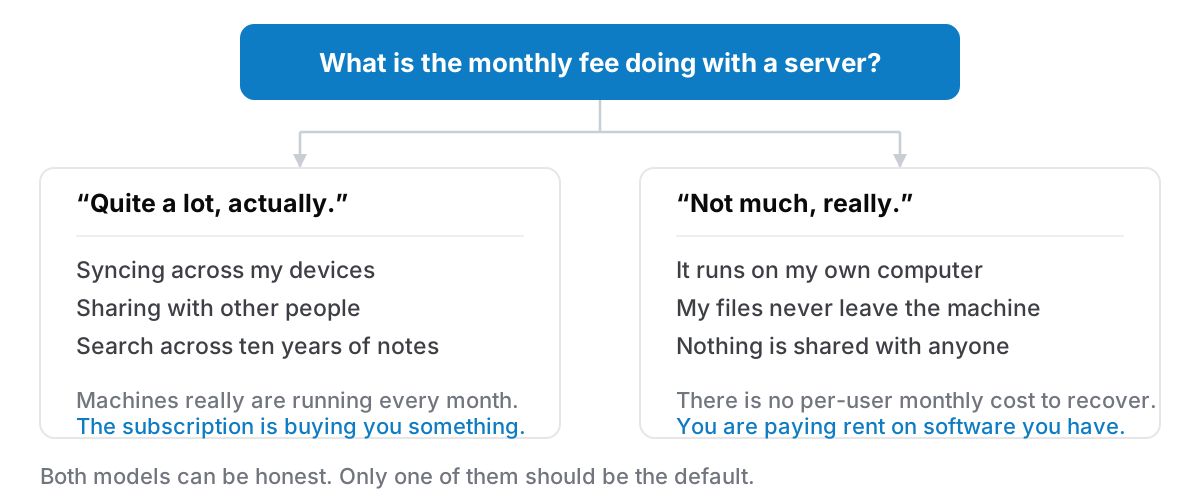
An app that keeps everything on your own computer — the local-first model — has no servers to pay for. There is no per-user monthly cost to recover, because there is no per-user monthly cost. The development work is real and ongoing, but that is funded by new customers, not by charging the existing ones rent for storage that doesn't exist.
That is why the local-first corner of the market still sells one-time licences while the cloud corner mostly cannot. It is not a moral difference between the developers. It is a difference in what the software actually costs to run.
So here is the test I apply when I am comparing two apps and one is $8 a month and the other is a single payment: ask what the monthly one is doing with a server. (What it means for an app to not need one is worth understanding before you decide.) If the answer is "syncing across my devices, sharing with my team, and running search across ten years of notes", the subscription is buying you something. If the answer is "not much, really", you are paying rent on software that lives on your laptop.
For the sake of declaring it: Cyanote, the app this blog belongs to, is one of the one-time ones — $7.99, local, no account, no server to pay for. That is the argument above applied to itself, and you should hold it to the same test.
Both models can be honest. Only one of them should be the default, and it isn't the one that became one.