Language apps are good at the part that is easy to make software for: vocabulary, drilling, spaced repetition. That part works, and if you are learning words, use one — Anki and its relatives will out-do anything you improvise.
What no app catches is the thing that happens in a real conversation: you wanted to say something and could not. That gap is the single most valuable piece of information your week produces, and it disappears within about four hours.
The gap log
One line, as soon as possible after the conversation.
What I wanted to say, in English. Exactly. "I would have picked it up but I was already late."
What I said instead, if anything. Usually something clumsy that worked.
What I actually needed — filled in later, when you look it up or ask someone.
That is it. Two lines in the moment, one filled in afterwards.
It works because it is your gap. A textbook chapter on the conditional is somebody's guess at what learners need. A list of eleven sentences you personally tried to say and could not is a curriculum built exactly to the shape of your life, in your register, about the things you actually talk about. Nothing bought can match it, and it costs a line a day.
What else is worth writing down
Corrections, verbatim. When someone corrects you — a teacher, a friend, a stranger — write down what you said and what they said, in their words. Do not paraphrase into the rule; the rule you infer is often wrong, and the raw correction stays useful.
Things you heard that surprised you. A phrasing that was not what you would have constructed. An idiom. The word that turned out not to mean what you assumed. These are the entries you will reread with most benefit.
Your own mistakes, with the pattern. Everyone has three or four errors they make constantly. Written down over a month, they become visible and therefore fixable; unwritten, they are simply how you speak.
The word you looked up twice. Looking something up twice means it did not stick and it recurs, which is precisely the definition of something worth learning deliberately. Mark it the second time.
Sentences, not words
The single most useful change most learners can make to what they write down.
A word in isolation is close to unusable. You learn a noun and still cannot deploy it, because you do not know its gender, which preposition it takes, what register it belongs to, or which verb goes with it. All of that is carried by a sentence and none of it by a dictionary entry.
So record the whole sentence you heard or needed, and mark the part you were learning. Three sentences with a word in context beat twenty isolated definitions, and if you do run flashcards, sentence cards outperform word cards for exactly this reason.
The grid, for the one thing that matters
Consistency is the only variable in language learning that is not in dispute. Twenty minutes daily beats three hours on Sunday, reliably, and everyone knows this and does it anyway.
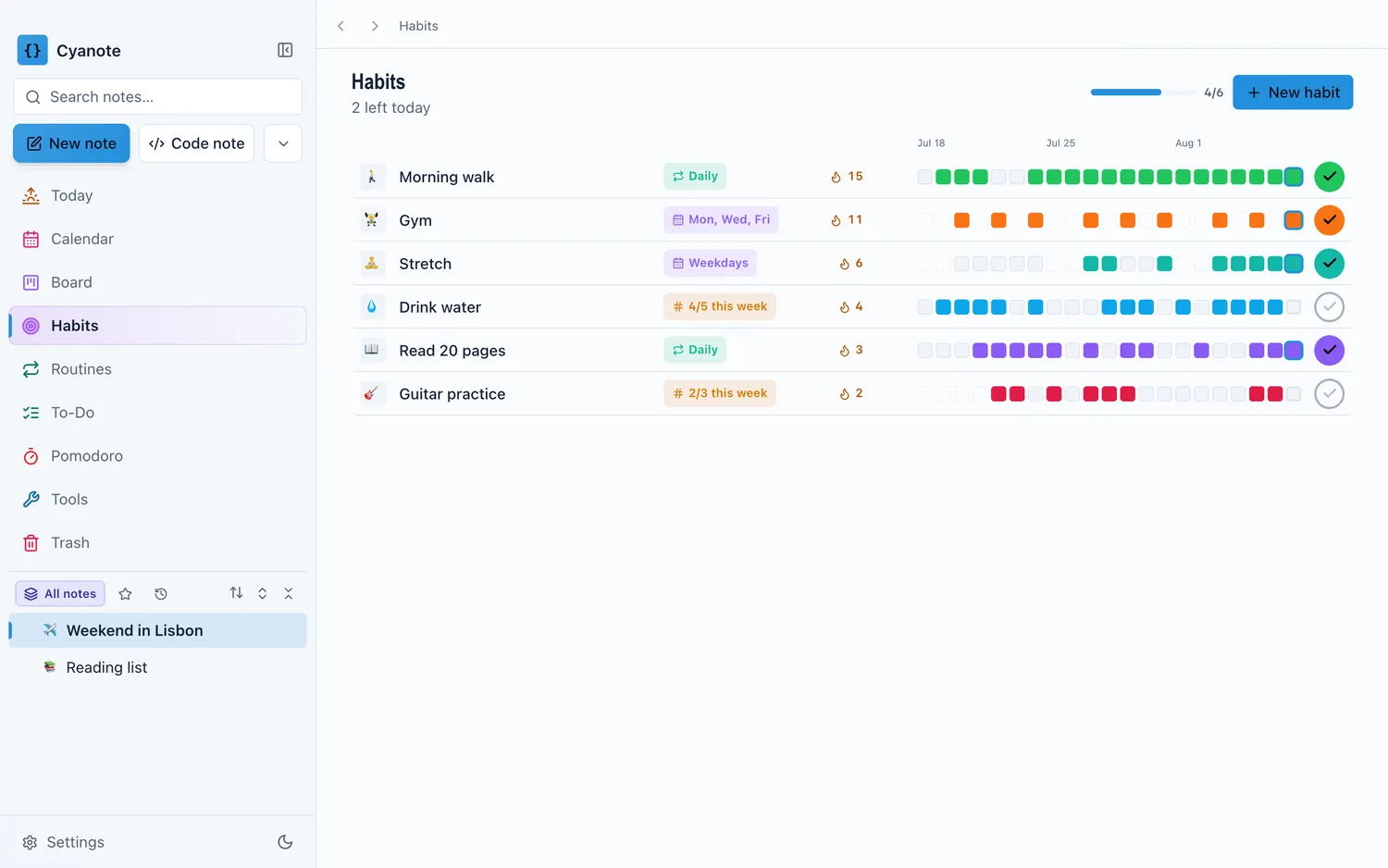
A grid of the last four weeks — did I do something in the language today, yes or no — is the right shape for that one question, and it is worth keeping separate from everything else. Not hours, not words learned, not app streaks. Did I turn up.
The reason a grid works better than a streak counter: a streak resets to zero and teaches you to stop looking after a missed day. A grid shows one gap on the 3rd and five ticks around it, which is an accurate picture of a good fortnight rather than a failure.
Reading it back
The part that turns a log into learning.
The gap log, weekly. Look up the three or four you have not filled in, and use them deliberately in the next conversation. That is the loop, and it closes in a week.
The mistakes, monthly. Patterns appear across entries that are invisible within one. Two months in, most people find one grammatical thing they get wrong constantly, and fixing that one thing produces more improvement than a month of vocabulary.
Everything, at six months. Read what you were struggling with in month one. This is the single best antidote to the plateau feeling, which is the main reason adults quit. Progress in a language is genuinely invisible from inside, and the only reliable measure is your own record of what used to be hard.
Where it should live
Somewhere it survives the app you are currently using.
Language learning happens over years and across tools: an app, then a class, then a tutor, then a period of just reading. Notes kept inside any one of those are notes you lose at the transition, and the transitions are frequent. A general notes collection that exports to a readable file is the thing still standing in year three, when the gap log from year one is genuinely interesting.
The practical requirements are small: it has to handle the script and any accented characters without fighting you, and search has to find them. Both are worth checking for a language that is not written in the alphabet you type in daily.
The honest version
Notes are not how you learn a language. Talking to people is, and everything here is a support structure for that.
But the gap log specifically is worth more than its size suggests, because it is the only artefact that records what you personally cannot yet do, and every other resource in the field is built around what learners in general cannot do. If you keep one thing, keep that.
Cyanote holds the parts that are notes and the part that is a grid: habits show the last four weeks as rows and columns, so a missed Tuesday is one click and a gap is visible straight down the page; notes hold the gap log and the corrections, searchable years later by any word in them, including in whatever script you write in. It is one local database on your own computer with a readable export, which for a record you want to still have when you are finally fluent is the part that matters.