The note is in your own words. You recognise the phrasing and the abbreviations are yours. You still cannot tell what it means.
"Checked the other one against S's version — same problem as before, so use the second approach for now." Every word is clear and the sentence is unreadable. Which other one. Which S. What problem. What were the two approaches.
You wrote it in your first year. It is now your fourth. Nothing has gone wrong with the file; the note is exactly as you left it. What has gone is everything that was in the room at the time, and the note was written on the assumption that it would still be there.
Context is free when you write and expensive when you read
This is the whole mechanism, and it explains almost every failure of an old note.
At the moment of writing, you have just been in the meeting. You know who S is, what the two approaches are, what happened last time. Writing any of that down feels absurd — padding, at best, and probably a waste of the thirty seconds you have before the next thing. So the note records the part that felt new, and silently relies on the rest.
At the moment of reading, all of that is gone, and none of it can be recovered from the note, because the note is what survived. There is nowhere else to look.
Most productivity advice treats this as a discipline problem — you should have written more. That is not quite right. Writing everything down is genuinely too slow, and people who try it stop within a fortnight. The trick is knowing which small number of things decay and adding only those.
The seven things that stop resolving
They are strikingly consistent, and if you fix them you have fixed most of it.
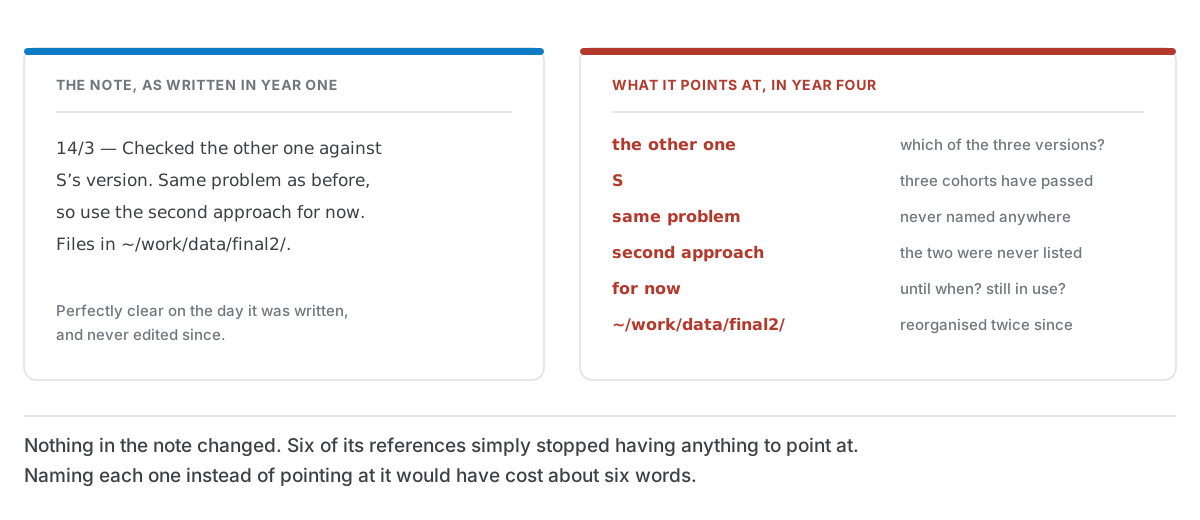
Pronouns and demonstratives. "It", "they", "this one", "the other version". Fine in the room, unrecoverable outside it.
Initials and first names without a role. "S said" is meaningless in year four, after three cohorts have passed through. "S (Sana, the second reader)" costs four words.
"The usual", "as discussed", "same as before". These point at a shared context that expires. Name the thing instead, once.
Relative dates. "Last week", "the new version", "the current draft", "recently". Every one of these is an arrow at a moving target. Absolute dates are always right and never need interpreting.
Paths and locations. ~/work/data/final2/ is a promise about a filesystem that will be reorganised twice before you finish. Record what the thing is as well as where it was.
Links out. A URL to a preprint, an internal wiki, a shared drive. Some fraction of these will be dead within four years, and the ones that break are not predictable. A link plus the title and author survives; a bare link does not.
Unstated conclusions. The note records what happened and not what you decided, because at the time the decision was obvious. It stops being obvious almost immediately.
Six or seven words per note, in total. That is the entire cost.
The question you were asking has changed
The second thing that happens over four years is subtler and cannot be fixed by writing more clearly.
Year-one notes were taken to answer a year-one question. By year three the project has narrowed, pivoted, or been quietly replaced by a better version of itself, and the old notes are not wrong — they are answers to a question you no longer have. They discuss a framing you have abandoned, using terms you have since redefined, weighing options that stopped being live two years ago.
This is why the instinct to reorganise old notes is usually a waste. The structure is not the problem. The problem is that a note written under the old framing needs a sentence at the top saying what it was for and why it stopped mattering — which is an annotation, not a reorganisation, and takes a minute rather than a weekend.
The most useful hour in a long project is the one spent at the end of each year rereading the previous year's notes and adding those sentences. Not tidying, not linking, not restructuring. Reading, and writing down what you now know that the note does not.
Some notes should be allowed to die
The corollary, and the part people find hardest: most of it does not need to survive.
A four-year project generates an enormous amount of writing that was useful on the day and has no further job — the working-out, the meeting you already acted on, the version of the argument you discarded in month eight. Keeping it costs nothing in disk and something real in attention, because it is what your searches will fill up with.
What is worth carrying forward is fairly small: decisions and why, methods and parameters, things that were tried and failed, the literature notes, anything about people, and anything you would need to defend. I have written separately about what to delete; the rule that transfers best to research is that you delete what you would not want to find, and you keep what somebody might ask you about.
The rest can stay where it falls. There is no need to curate it, and curating it is one of the more convincing ways to avoid writing a chapter.
Search is the only structure that survives
Related, and worth saying plainly: whatever folder scheme you invent in year one will not be the scheme you want in year four, because you did not yet know what the project was about.
This is not a failure of planning. It is unavoidable, and it means the structure you should rely on is the one that does not depend on having guessed correctly — search that actually works, across everything, instantly. Fold in a small number of durable conventions, like putting the date and the type of thing at the top of every note, and that is genuinely enough. Elaborate hierarchies are a bet on a version of the project that does not exist yet.
Somebody else will read these
At some point the notes stop being private. A supervisor asks how a number was produced. An examiner asks why you rejected an approach. A successor inherits the data and the scripts, sometimes after you have left and stopped answering email.
Research groups run on inherited notes, and the experience of receiving them is usually poor — the person who wrote them was writing for themselves, on the reasonable assumption that themselves was the only reader.
The test is the one from handing over your work: could someone competent continue from what is written, without asking you? For a research project the honest answer is usually no, and the gap between no and yes is not a documentation project. It is the seven things above, plus the annotation pass, plus one page per major piece of work saying what it was, where the data is, and what state it was left in.
Write that page when you finish a piece of work, not when you leave. At the end, you will be closing the project in a hurry, and it will not get written.
Four years is longer than most software
A practical point that only matters on this timescale.
A doctorate, a long study, a multi-year project — these outlast subscriptions, funding, laptops, institutional accounts and quite a few companies. A system that requires a valid card, an institutional login, or a service to still exist is a system with an expiry date you do not control, and the expiry will not arrive at a convenient moment.
The properties that matter over four years are unromantic: it works offline, it opens without asking anyone's permission, it stores things in a form you can read without the application, and everything comes out in one file when you want it to. Whatever you use, the test is whether you could walk away with the lot tomorrow.
And back it up somewhere that is not the laptop, in more than one place, tested at least once. Of everything in this article this is the only item where the failure is total rather than annoying.
The honest version
You cannot write notes that need no context. You can write notes that need a little less of it, and the difference between the two is about six words per note.
If you take one habit: name the thing instead of pointing at it. Not "the other version" but "the 2024 version with the wider sample". Not "as discussed" but the actual decision. It takes seconds and it is the single change that makes an old note readable.
If you take two: absolute dates, always. "Last week" is a note that decays from the moment it is written.
Everything else here is worth doing and none of it is worth stopping work for. The annotation pass at the end of a year, the page written when a piece of work finishes, the discipline of naming people with their roles — these accumulate quietly, and the payoff arrives in the last year, when you are writing up and reading four years of yourself at speed.
That is the week this is for. Not today.
If you want somewhere that opens instantly, searches four years of notes in one box and does not depend on an account that might expire before you finish, Cyanote is $7.99, once. The two piles this has to hold are the papers you have read and the record of what you actually did.