Making flashcards feels like revising. It involves the material, it takes hours, and it produces something you can point at. It is also, in itself, close to worthless. The learning happens when you test yourself on the cards, and a great many decks get built and never tested.
That is the trap of the whole category. The tool is fine; the activity around the tool is the substitute.
The two things that work
Decades of research on learning converge on a short list, and two items on it account for most of the effect.
Retrieval practice. Trying to recall something, from an empty page, without looking. This is not a way of checking what you know. The act of retrieval is itself what strengthens the memory. Rereading feels much better and does much less, because recognition is easy and produces the sensation of knowing without the work.
Spacing. Reviewing at increasing intervals rather than in one sitting. A given amount of study time spread across a week beats the same time in one evening, reliably and by a wide margin. Cramming works for tomorrow and is close to worthless for the month after.
Everything else — highlighting, rereading, summarising while looking at the source, colour-coding, rewriting notes neatly — is either weak or is producing artefacts rather than learning. That includes making cards, which is preparation, not practice.
The version that needs no software
The blank page. Close the book. Write everything you can remember about the topic. Then open the book and mark what you missed.
That is retrieval practice, complete, and it is more effective than almost anything you can do with an app, because it forces recall of structure as well as facts, which is what an exam actually asks for and what a card-by-card deck never tests.
The gaps are the output. What you could not produce is exactly what to study, and it is a far better guide than your sense of which parts feel shaky, which is systematically wrong: things feel familiar because you have read them recently, not because you know them.
The three-question note. After a lecture or a chapter, write three questions the material answers — questions, not summaries — and answer them from memory a few days later. Ten minutes, and it is retrieval plus spacing with no system to maintain.
The teaching test. Explain it out loud, to a person or to the wall, without notes. The place where you get vague is the place you do not understand, and it is startlingly obvious when you hear yourself do it.
The spacing, without an algorithm
Spaced repetition software computes an optimal interval per card. That is genuinely clever and, for most people revising for one exam, more machinery than the problem needs.
The crude version captures nearly all of the benefit: review at one day, three days, a week, three weeks.
Write those four dates in when you first study a topic. Four dated entries, and the schedule is done: no algorithm, no daily queue, no deck to maintain, and no risk of the backlog that kills most SRS attempts. What that costs you is optimality per item. What it saves you is the entire apparatus, which is what people actually abandon.
The daily queue is the real failure mode of flashcard apps. Miss four days, come back to 300 due cards, feel the dread, and stop. A fixed schedule of four sessions has no backlog to accumulate.
Where flashcards genuinely are the right tool
Not never, but for a specific shape of material.
Discrete pairs. Vocabulary in a new language. Anatomy. Drug names and doses. Kanji. Chemical symbols. Where the unit of knowledge really is one item mapped to one answer, cards are the correct representation and spaced repetition software is excellent.
Very large volumes over years. Medical school, a language you are learning indefinitely. When the collection is thousands of items and the horizon is years, the algorithm earns its complexity, and Anki is free, open source and has been the serious answer for a long time.
When you did not make the cards. A shared deck removes the card-making time, which was the part that was not learning anyway.
Where cards are the wrong tool is anything requiring understanding rather than recall: a proof, an argument, a system, why something happened. Chopping an explanation into forty question-answer pairs destroys the structure, and the structure was the thing worth learning.
Marking your own work honestly
The one discipline that decides whether any of this works.
When you recall something almost right, the temptation is to count it. Do not. "Nearly" is the state in which everything feels fine and nothing is retained. The value of retrieval practice comes from the difficulty, and grading yourself generously removes exactly the signal you were generating.
The same applies to the blank page. Mark it strictly, in a different colour, and keep the marked version. Three of those a week apart are a genuine record of progress, and unlike hours studied, they measure the thing you care about.
What notes are actually for here
Not for the revision itself, which happens on a blank page. For two other jobs.
The questions. Your list of "things this material answers", built as you go, is the source you test yourself from. It is the most reusable artefact of a course and it takes almost no time to accumulate.
The gap log. What you could not recall, each time. After three sessions, the items that appear all three times are your actual problem, and they are almost never the ones you would have guessed. This is the same pattern-across-entries effect: one session tells you little, five tell you exactly where to spend the last week.
Both want to be searchable and in the same place as the rest of your notes, because you will come back to them the following term, or the following year, in a state of having forgotten that you wrote them.
The honest version
If you are learning vocabulary or thousands of discrete facts, use Anki. It is free, it is very good, and nothing here is a substitute for it.
For everything else — understanding a subject, preparing for an exam that asks you to explain things, learning a field — the blank page plus four spaced sessions beats a deck you spent nine hours building, and it beats it on a fraction of the setup.
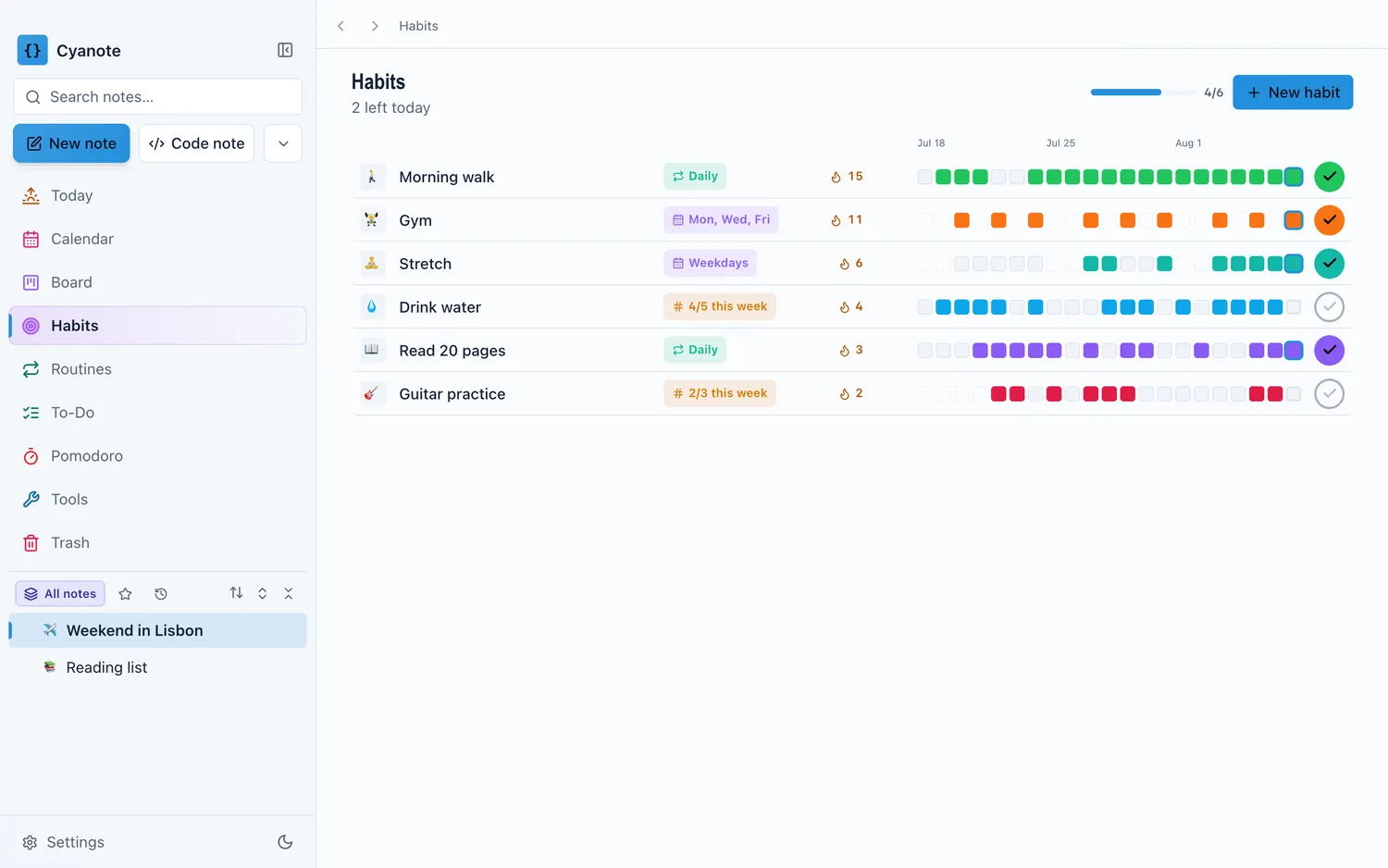
Cyanote holds the parts that are notes: a question list per topic, the gap log, the marked blank pages, all searchable with ⇧⌘F (Ctrl+Shift+F on Windows) a year later. Habits give you a grid of the days you actually did a session rather than hours you meant to, and tasks take the four review dates out of a typed sentence. There is no spaced-repetition algorithm and no card system, because the four-date version is what the app is for. If you want an algorithm, Anki is a better answer and always will be.