The plan is beautiful at 8:45. Three blocks of deep work, a slot for email, lunch, an afternoon of the thing you have been avoiding. By 10:40 it is wreckage, and by Thursday you have stopped writing plans, because the evidence is that they do not survive contact with the day.
The method is not the problem. Time blocking works; people who do it get more of the important thing done. What fails is the specific plan, and it fails for reasons that are predictable enough to design around.
Why the plan dies
It was written with no information. At 8:45 you do not know what today contains. You know what is scheduled, which is a subset. The plan is a forecast made by someone who has not read the weather.
It is full to the edges. A day planned at 100% capacity has no room for the thing that arrives, and something always arrives. The first interruption does not cost you thirty minutes; it costs you the plan, because every subsequent block is now wrong and re-planning mid-morning is a thing nobody does.
It ignores what your energy actually does. Almost everyone plans as though attention is flat across eight hours. Yours is not. Putting the hardest thing at 3pm because that is where the gap was is planning against yourself.
It confuses a plan with a promise. Miss two blocks and the day reads as a failure, which makes tomorrow's plan feel pointless. A plan that can only be kept perfectly is a plan you will stop making.
The version that survives
Smaller than you want it to be.
Three things, not twelve. Name the three that would make today worth having. Everything else is whatever else happens. Three is achievable on a bad day and leaves room on a good one, and — crucially — you can hold three in your head without consulting anything.
One block, not a full grid. Protect one stretch for the hardest of the three. Not the whole day: one. A single defended ninety minutes beats a fully-blocked day that collapses at the second interruption, because it is small enough to reschedule rather than abandon.
Put the hard thing where your attention actually is. For most people that is earlier than they schedule it. You already know your own answer to this; the plan just needs to stop ignoring it.
Leave half the day unassigned. This feels like under-planning and it is the single change that makes plans survive. The unassigned half is not slack. It is where the meeting that got moved, the thing that took twice as long, and the request that arrived at 11 all go. Without it, they take a block instead.
The two-minute version
Long enough to be useful, short enough that you will keep doing it.
Look at what is already fixed. Meetings, appointments, anything with a time on it. Not from memory, but from the calendar, because the whole failure mode is planning around a day you have half-remembered.
Look at what is due. Tasks with a date on them today, plus anything overdue. Again, not from memory.
Pick three. Written down, in the same place, so they are still there at 2pm when the morning has gone sideways and you have forgotten what today was supposed to be about.
Protect one block for the hardest one. In the calendar, as an actual event, so the hour is visibly gone when someone looks for a slot.
Two minutes. The reason it works is not the planning. It is that steps one and two replace guessing with looking.
What to do when it goes wrong by 11
It will. The question is only what happens next.
Do not re-plan the whole day. That is a twenty-minute job you will not do, and skipping it is what makes people declare the plan dead.
Ask one question: is the one block still possible today? If yes, move it and carry on. If no, decide now which of the three is being dropped, deliberately, rather than discovering at 6pm that it was all three.
Let the other two go without ceremony. A day where one of three important things happened is a normal good day. Treating that as failure is the thing that stops people planning at all, and it is a scoring error rather than a productivity one.
Where the plan should live
In the same place as the day it is planning.
If your calendar is in one app, your tasks in another, and your plan written in a third, then the plan was necessarily written from memory. You would have had to open three windows to write it accurately, and at 8:45 nobody does. That is the mechanical reason day plans are so often wrong about what the day contains, and it has nothing to do with willpower.
One view with the schedule, what is due and what is outstanding is not a nicer interface. It is the difference between a plan based on today and a plan based on your recollection of today, which is the same argument as keeping notes, tasks and the calendar in one window.
The honest version
If your days are genuinely dictated by other people — clinical shifts, back-to-back client work, anything where the calendar is not yours — planning is not the lever and this post will not help. The lever there is defending one block a week, not planning a day.
And if you have tried time blocking repeatedly and it keeps failing, the diagnosis is usually not that you need a better system. It is that the plans were too full. Try three things and one block for a fortnight before concluding anything about yourself.
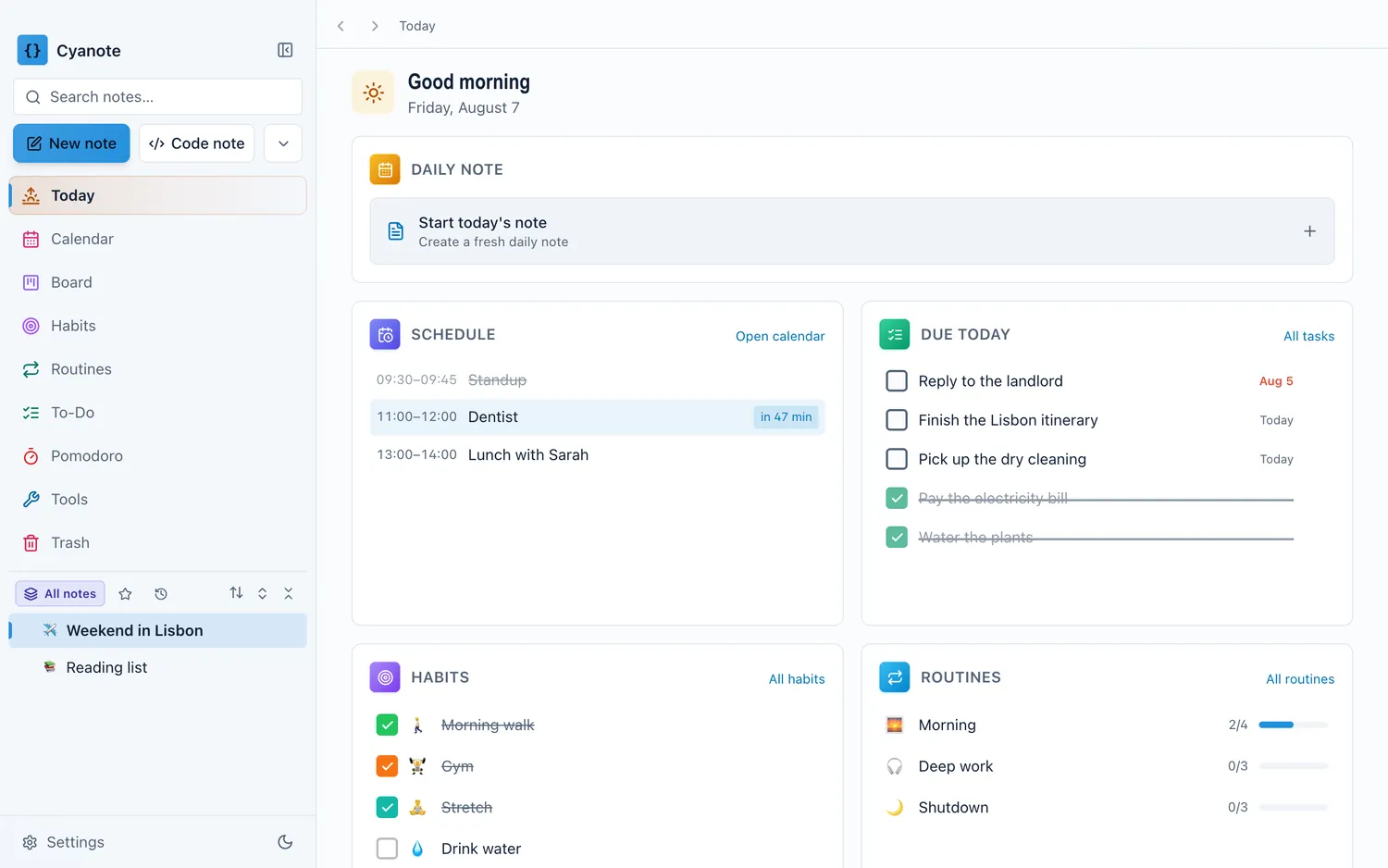
Cyanote's Today view is the two-minute version made concrete: the day's schedule, what is due, the habits still outstanding and the routines not yet run, with the next event counting down beside it. Tasks take a date and a priority from the sentence you type them in, and a calendar block is an event you drag into place. All of it in one window and one local database on your own computer, so the two minutes are two minutes of looking, rather than two minutes of opening things.