Moving house is not a hard project. It is a long one, made of several hundred small facts arriving from eleven organisations over four months, most of them by phone or email, none of them in one place.
The packing is the part everyone dreads and the part that always gets done, because it is physical and it has a deadline. The failures are elsewhere, and they are the same three every time.
The three failures
A date passed and nobody knew. The notice period on your current place. The date the mortgage offer expires. The last day to cancel the broadband without a fee. Every one of these is a date somebody told you once, in passing, three months before it mattered.
Nobody could find the fact. The reference number, the meter reading, the name of the person who said the thing, the exact wording of what the agent promised about the fridge. Somewhere in an email, or a call you did not write up.
Nobody knows who is waiting on whom. The solicitor is waiting on the survey, you think, or possibly on you. Chains stall for weeks because nobody is tracking whose move it is, and the person best placed to notice is you.
None of the three is a packing problem, and none of them is fixed by a checklist from the internet.
One note per organisation
Not one note called "Moving". Eleven notes, one per party: the estate agent, the solicitor, the mortgage lender, the surveyor, the removal company, each utility, the council, the broadband provider.
At the top of each: who they are, the reference number, the named contact and their direct line, and what they are responsible for. Below: dated entries, after every call.
The reason for the split is the moment it is used. You are on hold, they have asked for your reference, and someone is about to tell you something. You need one note open, containing that organisation's reference and what they said last time. A single "Moving" note means scrolling through four months of everything to find the utility bit while somebody waits on the line.
It is the same shape as a client note, and a move is genuinely a project with eleven suppliers.
Write up every call, immediately
The one discipline, and it is worth more than everything else here combined.
Four lines within two minutes of hanging up: who you spoke to, what they said, what they committed to, and by when. Especially the name. "I spoke to someone last week who said it was fine" carries no weight; "I spoke to Daniel on the 14th, who confirmed the completion date was still the 30th" carries a great deal.
Property transactions run on verbal assurances that nobody records, and the person with a dated note of who said what has a substantial advantage in every subsequent disagreement. This is not adversarial. Most of the time it just resolves an honest confusion in ten seconds instead of a fortnight.
Every date with money on it, in the calendar
The moment you learn it, as an event, with a reminder well ahead.
Notice period on your current place. Mortgage offer expiry. Fixed-rate end date. Insurance start — buildings insurance normally needs to be live from exchange rather than completion, and that is the classic expensive gap. Cancellation deadlines for services. Council tax notification. The final meter readings.
A month's notice for anything with a fee attached, because a week's notice is notice that it is happening, and a month is enough to do something about it. Same principle as life admin generally, compressed into four months where the consequences are larger.
A board for the chain
The third failure — nobody knows who is waiting on whom — is what a board is for.
Three columns: waiting on me, waiting on them, done. Every outstanding item as a card. Ten seconds, once a day, and you know whether it has been eleven days since anyone touched the searches.
This matters more than it sounds because chains stall silently. Nobody tells you nothing is happening; things simply do not move, and by the time it is obvious you have lost three weeks. A board makes stalling visible, and the polite chase on day four costs nothing and moves things.
The specific things people forget
Collected from the way these go wrong.
Photograph every meter, on the day, with the whole meter and the serial number in frame. Both properties. Disputed readings are the single most common post-move billing problem and a photograph settles them instantly.
Photograph the condition of things on the day, if you rent. Both ends. It is the deposit.
Write down what is included in the sale, in the exact words used. Fixtures, appliances, curtains, the shed. This is where the small bitter arguments happen, and they are entirely preventable with one dated line.
Keep the completion statement and the paperwork. Some of it is needed years later for tax.
Write down where you put the important box. Genuinely. The one with the documents, the chargers and the kettle.
The week after
Ten minutes, once you have moved, while it is fresh.
What went wrong, and what you would do differently. Not for this move — for the next one, or for the friend who asks. It is remarkable how completely this evaporates within a month.
What it actually cost, in total, including the things nobody counts: the removal, the fees, the two weeks of eating out, the things that had to be replaced. This is the number you will want the next time you are deciding whether to move, and it is not recoverable later.
Anything still outstanding. There is always something — a refund, a final bill, a thing the seller was supposed to send. It goes on the task list with a date, because the relief of having moved is exactly when unfinished things get dropped.
The honest version
A move is four months of admin and there is no system that makes it enjoyable. What notes do is remove the specific failures that turn an expensive stressful process into a more expensive one: a missed cancellation, an assurance nobody recorded, three weeks lost to a stalled chain.
If you do one thing: write up every phone call, with the name and the date, within two minutes. That single habit prevents most of what goes wrong.
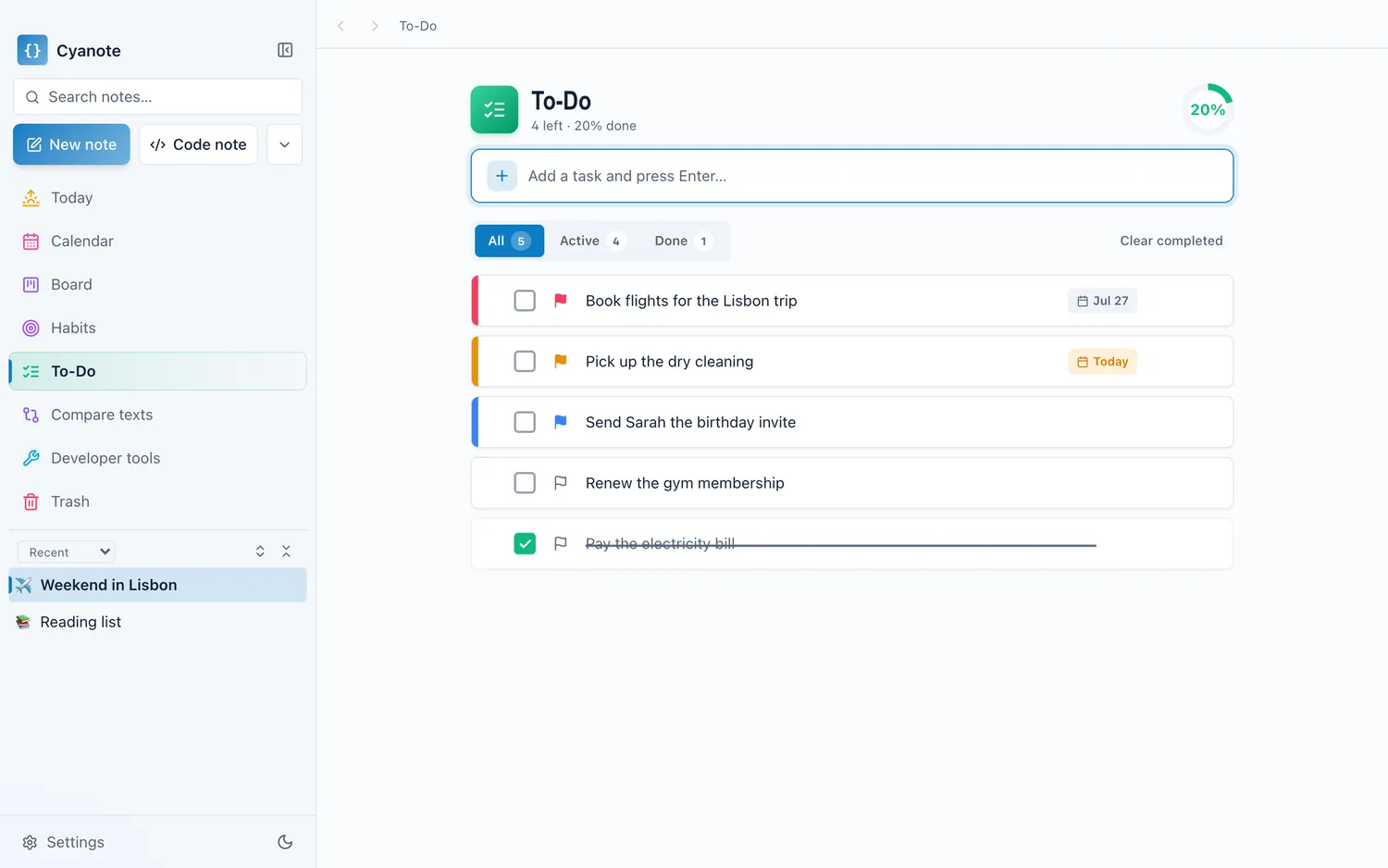
Cyanote holds all three parts in one window: a note per organisation with the references at the top, a calendar with reminders a day, an hour or thirty minutes ahead for every date with money attached, tasks that take their date out of the sentence you type, and a board for the chain. Photographs of meters and paperwork go in the notes rather than in a URL somewhere. It is one local database on your own computer, which for a file containing your reference numbers, your solicitor's correspondence and photographs of your documents is where it should be.