Halfway down the first page you realise you have read this before.
You remember the shape of the argument. You do not remember what you thought of it, whether you decided the sample was too small, or whether this is the one whose second half turned out to be useful. There is no note, or there is a note and you cannot find it, and the cheapest way forward is to read the whole thing again.
That is an hour, and it is not the only hour. Over a literature review it is most of a month.
Reading for research is a different job
I have written before about reading notes without a highlighting app, and most of that holds here. But research reading fails in two ways that ordinary reading does not, and they are what shape everything below.
The volume is wrong for memory. You will touch several hundred titles, skim a hundred abstracts, read perhaps forty properly and cite maybe fifteen. No system that depends on remembering which is which survives that, and the failure is not gradual — it arrives about six weeks in, all at once, when two papers by the same group blur together.
You have to be able to prove it later. Ordinary reading leaves an impression, which is fine, because nobody audits an impression. Research reading has to produce a claim attached to a source attached to a page, defensible in a viva or a review, possibly three years after you last had the paper open.
Those two together mean the note is not a souvenir of having read something. It is a working record with a job.
Most papers do not deserve a note
The single most useful thing to understand about a literature review is that the pile has stages, and each stage produces a different amount of writing. People exhaust themselves writing full notes on everything at the top of the funnel and give up.
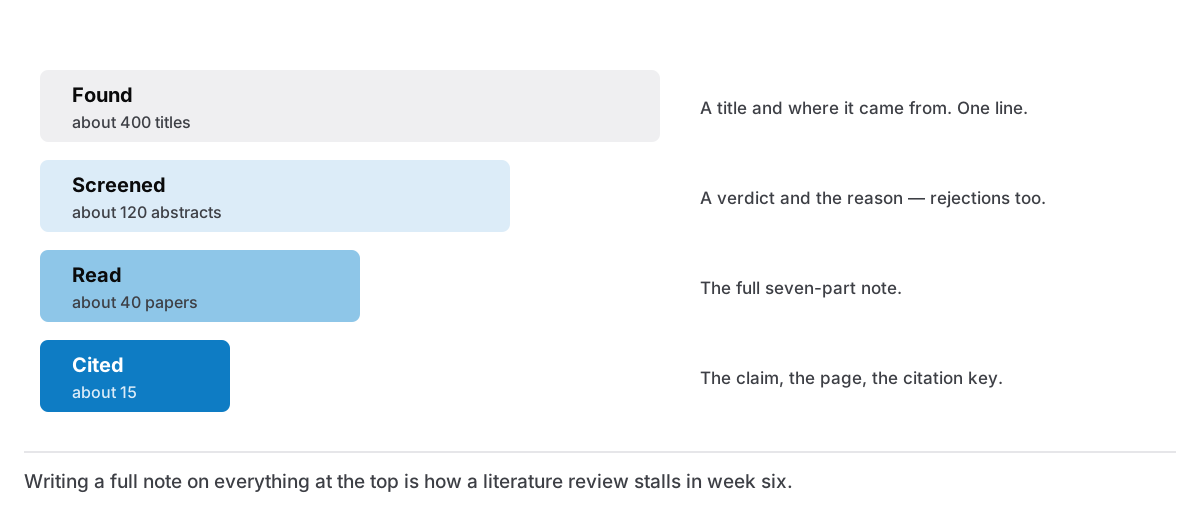
Found. A title and an author and nothing else. One line, in one list. You are only recording that it exists and where it came from.
Screened. You read the abstract and made a decision. This is the stage everyone skips and it is the one that pays the most, for a reason that only becomes obvious later: record the rejections and why. One line — "not relevant, different population" or "methods paper, no data" — costs five seconds and stops you rediscovering the same paper in four months, from a different search, and screening it again with exactly the same reasoning.
Read. A proper note, described below. Reserve this for papers you have actually read properly, which will be far fewer than you expect.
Cited. The claim, the page, and the citation key, written into the note the moment you use it in a draft.
What goes in a note for a paper you have read
Seven things. It takes ten minutes at the end of a read, and it is the difference between a note that answers questions and a note that is a summary of something you could have reread anyway.
The full citation, first, always. Authors, year, title, venue, DOI. It is the most boring line and the one whose absence costs the most, because reconstructing a reference from a half-remembered title is a genuinely miserable hour.
The claim, in one sentence, in your own words. Not the abstract. What this paper argues, as you would say it to someone in a corridor. If you cannot write this sentence, you have not finished reading.
The method and the sample. What they actually did, to whom, how many, and over how long. This is what decides whether you can use the paper for what you want to use it for, and it is the part that gets lost first.
The specific number or quote you might use — with the page. Not "they found a large effect". The figure, the table it is in, the page it is on.
What it is for, in your argument. One line about why this is in your pile at all: supports the second chapter, contradicts the thing everyone cites, is the standard reference for the method. This line is what makes the note findable in a year, because by then you will search for your problem, not for their title.
What is wrong with it. The limitation they admit, and the one they do not. Your own objection, written while you still have it. This is the part you will never reconstruct and the part a supervisor or reviewer will ask about first.
Who it cites that you should read. Two or three names, maximum. The citation trail is how literature reviews actually get built, and it goes stale the moment you close the PDF.
The quotation rule that matters more than it looks
In your own notes, a direct quotation must be visibly, unmistakably a quotation: in quote marks, with the page number, every time. A paraphrase must be visibly a paraphrase.
This sounds like pedantry and it is not. The common route into accidental plagiarism is not dishonesty; it is a note taken in a hurry, eighteen months ago, where a sentence was copied down without quote marks and has since been read as your own phrasing. By the time it reaches a draft, the distinction is unrecoverable — you cannot tell, and neither can anyone else, without going back to the source.
Pick a convention on day one and never break it. Quotes in quote marks with a page number. Your own words plain. Your own opinions marked as yours — a leading > or [me] or anything at all, as long as it is consistent. The cost is a keystroke. The failure mode is a career problem.
The question you will be asked in two years
"Where did that come from?"
Someone will point at a sentence in your draft — a supervisor, a reviewer, an examiner, you at 2am — and ask which source it rests on. The path from any claim in your writing back to a page in a paper has to be walkable, and it is either built as you go or not at all.
The habit is small: when you use a source in a draft, write the citation key into that paper's note, next to the claim it supports. It takes three seconds and it turns the collection from a pile of summaries into an index that runs both ways. You can ask what a paper says, and you can ask what rests on a paper — which is the question that matters when one of them turns out to be retracted, superseded, or weaker than you thought.
A reference manager and a notes app are not the same tool
Be fair about this, because a lot of writing on the subject is not.
A reference manager — Zotero, or whatever your field uses — stores metadata, talks to your word processor, formats a bibliography in whatever style is demanded, and renumbers it when you reorder a chapter. That is real work, it is fiddly, and you should not do it by hand. Nothing in this article replaces it.
What reference managers are generally poor at is the thinking: the objection you had, the connection to the other paper, the reason this one matters to chapter three. That lives better as prose in a note, and the two are joined by the citation key, which is the only thing that needs to exist in both places.
Use both. Let the reference manager own the bibliography and let your notes own your opinions.
What this is not
It is not a second brain. The temptation, once you have two hundred notes and a linking feature, is to start tending the collection — refactoring the structure, building the index, adding the connections — and to feel productive doing it.
That is a well-documented way to spend a year, and I have written about it at more length elsewhere. The literature notes exist to produce a chapter. If a session of organising has not moved a chapter, it was not work, however much it felt like it.
Where it should live
Unpublished research is not ordinary text. It is unpublished results, an unfinished argument, and often data about people, held under an ethics approval that says specific things about where it may be stored.
That is a strong argument for notes on a machine you control, with no account, no sync to a third party and no vendor whose terms can change mid-degree. It is also an argument that your institution may have its own rules about — check them, because for interview data or anything identifiable, "on my laptop" is a claim you may have to defend, and it is a much better claim when the laptop is encrypted and the backup is one you can describe.
The practical point is that a doctorate outlasts most software subscriptions, and that your own notes from year one will be read by someone who has forgotten writing them. Something you paid for once, that keeps working offline and exports everything to a file you can read without it, is a better bet across four years than something that requires a card to stay valid. That is the local-first argument with an unusually long time horizon attached.
The honest version
This is more discipline than most people manage, and the good news is that the returns are front-loaded and uneven. Recording your rejections and writing the full citation first are perhaps five per cent of the effort and most of the benefit. If you do nothing else, do those two.
The rest compounds slowly and pays out at the worst moments — the week before a deadline, the morning of a viva, the day a reviewer asks where a number came from. That is not a satisfying pitch. It is, unfortunately, an accurate one.
Start with the paper on your desk right now. Write the citation, the one-sentence claim and your objection, and see how long it takes. It will be less time than reading it a second time.
If you want somewhere to keep them that opens instantly, searches across all of it, and has no account to lose between the start of a doctorate and the end of it, Cyanote is $7.99, once. The research log that goes alongside it is a different note with a different job, and it is the next thing to get right.