A habit tracker has exactly one mechanism: you see it, and seeing it either continues a streak or breaks one. That's the entire product. There's no clever algorithm underneath a habit app. The whole design problem is getting a small piece of information in front of you at the right moment, reliably, for months.
Which makes it a strange category to put behind its own app icon, its own launch, its own moment of remembering it exists.
The mechanism is visibility, not features
Most habit-tracking apps compete on what happens around the checkmark — streak graphics, charts, badges, social accountability, reminders tuned by machine learning. Some of that helps some people. None of it is the mechanism.
The mechanism is: you open something, you see today's habits, you mark them or you don't. Everything else is decoration on top of a single daily glance. Which means the question that actually matters is "which app am I actually going to open every day without being asked," not "which app has the best streak visualisation."
Why a dedicated habit app struggles with its own job
This is the part that's a little unfair to habit apps, because it's not a quality problem. It's a category problem.
A habit tracker is, almost by definition, an app you don't need for anything else. You don't check it to write something down, look something up, or get something done. You check it to check it. That makes it the easiest app on your Mac to simply stop opening, because nothing else pulls you toward it. A notes app gets opened because you need to write a note. A habit tracker gets opened because you remembered to open the habit tracker, which is precisely the kind of remembering a habit tracker exists to replace.
The apps that work around this lean hard on notifications — a push reminder every evening, sometimes several. That's a real solution, and it's also the reason people delete habit-tracking apps: the badge count and the reminders become their own small source of guilt, decoupled from whatever the habit actually was.
What changes when it's not a separate app
Not a redesign of the mechanism. The same glance, the same checkmark. What changes is where that glance happens.
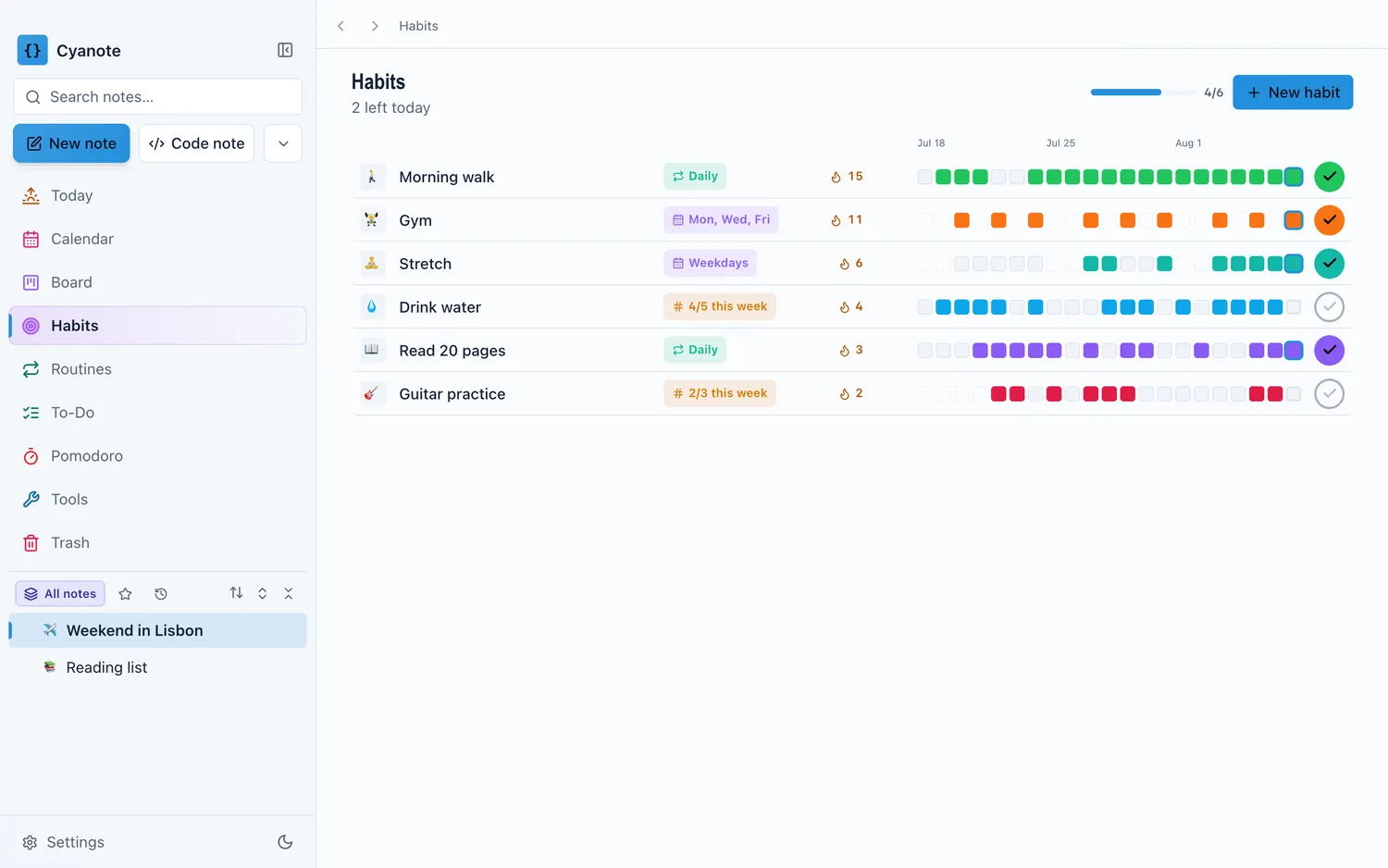
If your habits live in the same window as the notes you're already writing and the to-dos you're already checking, the habit tracker stops needing its own reason to be opened. You see today's habits because you were already there for something else, the same way a kitchen calendar gets glanced at while you're getting coffee rather than because you scheduled time to look at a calendar. The visibility the whole category depends on gets inherited from an app you were opening anyway, instead of manufactured by a notification.
This is the same argument I made about the weekly review fitting into twenty minutes rather than becoming its own ceremony. The systems that survive are usually the ones that attach to something you were already doing, not the ones that ask for a new standalone ritual. A habit tracker you have to remember to open is asking for a ritual. One sitting inside your daily notes is attaching to one you already have.
A dedicated habit app is a perfectly good answer
Worth saying plainly, because a page selling the bundled version has an obvious reason not to.
If you want serious analytics on your habits — correlation between habits, long-range charts, a gamified system that genuinely works for you — a dedicated tracker will do more than a habit list bolted onto a notes app ever will. As of 16 August 2026, Streaks is a one-time $5.99 purchase on the App Store and has been one of the more respected habit trackers on Apple platforms for years; Habitica turns the whole thing into an RPG with a free tier, for people who are honestly motivated by that. Both have spent years refining exactly this one thing, and if what's currently stopping you is that your habit tracker isn't good enough at being a habit tracker, switching to a plainer, less-featured one won't fix that.
The bundled version isn't trying to out-feature them. It's solving a different, more common failure: not "my habit tracker's charts aren't detailed enough" but "I stopped opening my habit tracker in February and didn't notice until April."
What actually breaks a habit-tracking streak
Worth naming, because it's rarely the habit itself.
Too many habits at once. A list of eleven things to check every day is a chore, not a habit tracker, and the eleventh item is the one that quietly stops getting checked first — followed, a few weeks later, by all of them.
No room for a miss. A single missed day that resets a 40-day streak to zero teaches exactly one lesson: stop looking at the app. The trackers that hold up long-term usually let a streak bend without breaking outright.
The tracker itself becoming the thing you avoid. If checking in has started to feel like a small guilt trip rather than a small win, the app has started working against its own mechanism.
None of these is fixed by more features. They're fixed by fewer habits, more forgiveness, and — the part this post is actually about — a lower cost to glancing at the thing in the first place.
The honest version of the choice
If you're deep into habit tracking as its own discipline — chains, correlations, a system you've tuned over years — a dedicated app that's spent that long on the one feature will serve you better than a habit list living inside a bigger app.
For the more ordinary case — a handful of habits you want to keep half an eye on without giving them their own icon, their own notifications, and their own moment of remembering to open it — the bundled version's whole argument is that it doesn't need a mechanism of its own. It borrows the one you already have, from the app you were opening anyway.
Cyanote's habit tracker sits in the same window as the notes and the to-dos, in a local database on your own computer, with no account and no streak data leaving your machine. It is one part of five, not the deepest habit tracker available, and if the depth is what you're after, Streaks or Habitica will out-feature it honestly.