The work is finished, the invoice is sent, and the feeling is that the job is done.
It is not. The invoice has left your side and entered somebody else's process, and what happens next is almost entirely determined by whether anyone is tracking it. At their end, frequently, nobody is. Accounts payable pays what reaches it in the right shape at the right point in a cycle; anything that arrives at the wrong address, without a purchase order number, or two days after the run, waits a month without anyone deciding that it should.
Which means the tracking has to be yours. Not because clients are dishonest — most late payment is nobody's decision at all — but because you are the only party with a reason to notice.
An invoice is not a document, it is a position
The document is the easy part. Any invoicing tool, spreadsheet or template will produce something legally adequate.
What people do not keep is the position: which invoices are outstanding, how old each one is, what stage it reached, and who is sitting on it. That information is not in the PDF. It usually lives in a sent-items folder and the back of your head, which is why the honest answer to "how much are you owed right now?" is, for most freelancers, a pause.
The pause is the problem. You cannot chase what you cannot see, and an invoice nobody chases at sixty days often becomes an invoice nobody chases at ninety.
What you need to know about each one
Six facts. They fit in a short block at the top of a note, and every one of them is something you will otherwise go looking for while drafting an awkward email.
The invoice number and the amount. Sequential numbers, no gaps. Whoever does your books will care, and so will you when two invoices to the same client are both outstanding and you need to say which one you mean.
The date it was sent, and the terms. "Net 30" is not a date. Work out the actual day it becomes overdue and write that down, because that is the thing you are going to act on.
The purchase order or reference number. For any client with a finance department, this is the single most common reason for a silent delay. No PO number, no payment, and nobody will tell you — the invoice simply sits in a queue it can never leave.
Who approves it, by name. Not the company. A person, usually the one who hired you, who has to click something before finance sees it. Most "late payments" are an unclicked approval by somebody on annual leave.
Where to send the chase. Often a different address from the one that commissioned the work. Getting this wrong means your polite reminder goes to someone with no ability to act on it.
What happened, dated. Sent. Acknowledged. Chased. Promised for the 14th. Paid. Appended, never rewritten, so that by the third chase you can say exactly what was agreed and when, which changes the tone of the conversation entirely.
A board beats a list
Outstanding invoices have states, and states are what a board is for. A list tells you what exists; a board tells you where everything is.
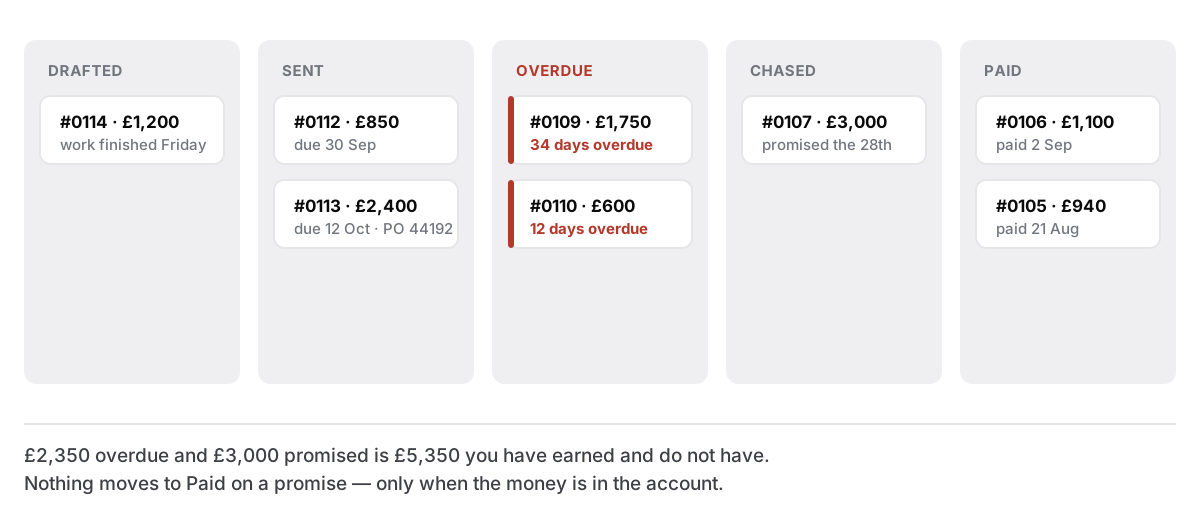
Five columns is enough: Drafted, Sent, Overdue, Chased, Paid. A card per invoice, carrying the six facts above.
The value is not the tidiness. It is that thirty seconds on a Monday morning tells you the thing you would otherwise need an hour and a bank statement to work out: what is owed, and what is old. A personal Kanban board is usually recommended for work in progress. Money in progress suits it better, because the states are genuinely distinct and the ageing is what you need to see.
Two rules keep it honest. A card moves to Sent only when the invoice has actually left, with the PDF attached where you can find it. Nothing moves to Paid on a promise — only when the money is in the account.
Chasing, on a schedule, without feeling anything about it
The reason freelancers chase late is not forgetfulness. It is that chasing feels like an accusation, so it gets deferred until the resentment outweighs the awkwardness, at which point the email is worse than it would have been at day 31.
The fix is to take the decision out of the moment. When you send an invoice, put the chase dates in the calendar immediately — the day after it falls due, then a week later, then a fortnight after that. Reminders you do not have to decide about are reminders that you do not start ignoring, and a chase that arrives on schedule reads as process rather than as grievance.
The messages themselves get shorter as they go, not longer.
Day one overdue. Short, friendly, assume an oversight, re-attach the invoice, state the number and the date it was due. Most invoices clear here, because for most of them nobody had noticed either.
Day seven. Same, plus a direct question: has it been approved, and if not, who is it with? You are asking them to locate it, which is a different request from asking them to pay.
Day fourteen. Copy in accounts payable directly and ask for a payment date. Not payment — a date. A specific date is something a person can give you without authority to release funds, and once you have one, you have something to hold them to.
Beyond that, what is available to you depends entirely on where you are and what your contract says, and this is the point at which the answer stops being a workflow question. Know in advance what your own terms and local rules allow, before you need it.
Write every reply into the card the day it arrives. The single most useful sentence in a difficult payment conversation is "on the 14th you said it would be paid by the 28th" — and you can only say it if somebody wrote it down.
The trail you will want at the end of the year
At some point you have to account for the year, to a tax authority, an accountant, or both. What they need varies by country and by how you are set up, and this is not the place for an answer to that — ask the person who signs off your return.
What does not vary is that the answer is much easier to give if the records exist as they happen. Four things are worth keeping as you go:
What you invoiced, and when it was paid. The board already knows this, if paid cards are archived rather than deleted. Closing a project should include closing its money.
Receipts, photographed on the day. Till receipts fade, sometimes within a couple of years. A photograph taken when the receipt is new costs ten seconds and survives; the paper in the shoebox may not.
Expenses, written at the time. What it was, what it was for, and which client or project it belonged to. The "what it was for" is the part you cannot reconstruct in April from a card statement line reading a coffee shop and £4.60.
Mileage or travel, logged the same day. It is the record people most often reconstruct from memory, and reconstruction is exactly what you do not want to be doing.
None of that is bookkeeping. It is the raw material bookkeeping runs on, and the difference between having it and not is the difference between an afternoon and a very bad weekend.
Fifteen minutes on a Friday
All of this collapses into one recurring appointment, and the appointment is what makes it work rather than the notes.
Once a week: invoice anything finished, move every card to its true column, read the Overdue column, send whatever chase is due, and photograph the week's receipts. Fifteen minutes, usually less.
The alternative is not doing it weekly in less time. It is doing it in March, across eleven months of email archaeology, with a deadline. If you already run a weekly review, money is the section most people leave out, and it is the one with a number attached.
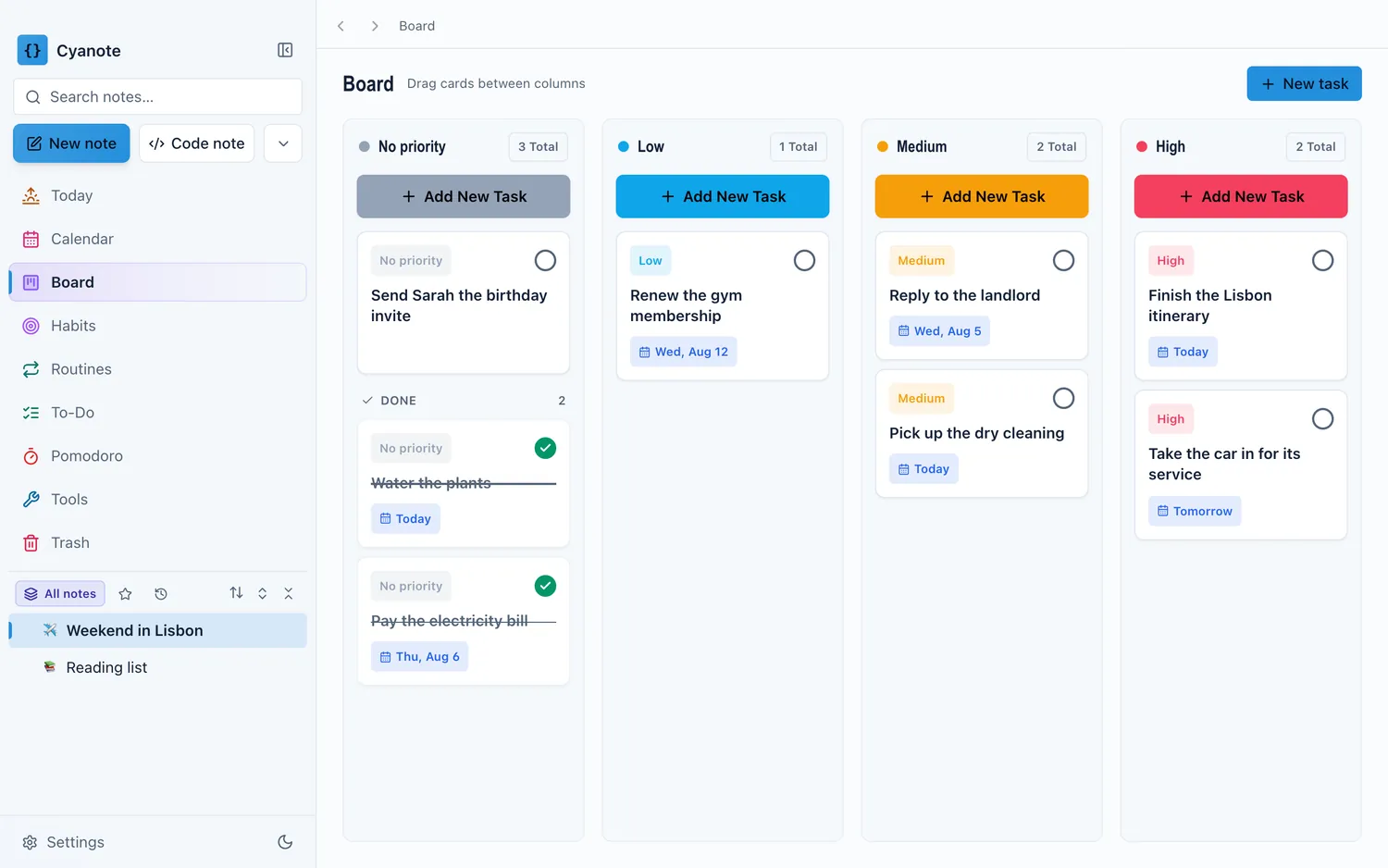
Where it should live
Invoicing software will do this, and if you are billing thirty clients a month you should probably buy some.
Below that volume, the case for keeping it in the same place as the work is straightforward: the note about what you agreed, the scope you actually delivered, the emails you summarised and the invoice that came out of it are all one story, and splitting them across two applications means reconstructing the story every time there is a dispute about scope. That is the same argument as keeping client work straight — the invoice is simply the last entry in the client's note rather than a separate universe.
It also means your financial position is not sitting in a third-party account you can be locked out of, and not readable by anyone but you, which for a document listing your clients and your rates is worth something.
The honest version
Nothing here makes a client pay you. A client who has decided not to pay will not be moved by a well-maintained board.
What it changes is the large, dull middle: the invoices that are late because nobody noticed, missing a PO number, waiting on an approval by someone who has forgotten, or sent to the wrong address. That is most late payment, and every one of those is fixed by somebody noticing on the right day and sending three sentences.
The board is how you notice. The calendar is how you notice on time. The dated log is how the third conversation goes better than the second.
If you want all three in one window, next to the notes for the work itself, Cyanote is $7.99, once — a board, a calendar, notes and no subscription, which is a reasonable thing to expect from software that exists to help you get paid.