Todoist is the task manager most people have tried, and it earned that position. Natural-language input that actually parses, an app on every platform, an API, integrations with everything, and fifteen years of steady development behind it.
It is also, for a lot of people, the last subscription left after they cancelled the others, which makes it the one that gets examined.
What the tiers actually are
From todoist.com/pricing, checked 1 September 2026:
Beginner (free): 5 personal projects, 3 filter views, 1 week of activity history, 5 MB file uploads, task reminders, list and board layouts.
Pro: US$5 per user per month, $60 billed yearly. 300 personal projects, 150 filter views, calendar layout, task duration, custom reminders, full reporting history, 100 MB uploads.
Business: US$8 per user per month, $96 a year, for shared team workspaces.
The number that pushes people onto Pro is almost always the first one. Five projects sounds like plenty until you realise that in Todoist a project is the only container there is, so Work, Home, a side project, a house move and a reading list is the whole allowance, and the sixth thing in your life has nowhere to go.
The free tier is a shape, not a size
That is the thing worth naming. Five projects is not a stingy quantity, it is a structural constraint, and it pushes you into one of two behaviours.
Either you flatten everything into a handful of giant projects and use labels and filters to carve them back up, except filters are capped at three on the free tier, so that route closes too. Or you delete finished projects to make room, which means closing a project becomes an act of destruction rather than an archive.
Both of those are the free tier working as intended. It is a well-designed funnel and there is nothing dishonest about it. But it is worth recognising the moment for what it is: you are not upgrading because you outgrew a task manager, you are upgrading because you have five containers and six areas of life.
What $60 a year is genuinely funding
Be fair about this, because a lot of "cancel your subscriptions" writing is not.
Todoist syncs across web, macOS, Windows, iOS, Android and a watch, in near real time, with conflict resolution, offline queuing and shared projects. That is a service with servers behind it and a permanent per-user cost, and a one-time payment cannot fund a permanent per-user cost, whatever anyone promises at the point of sale.
If you assign tasks to other people, or capture on a phone and work on a laptop, or use the integrations, you are using the thing you are paying for. $60 a year is a fair price for it and cancelling would be a downgrade dressed up as a saving.
The people who should look again are the ones who added Todoist to a phone in 2021, do everything on one computer, and have not opened the mobile app in a year.
Getting your tasks out
Export per project, as CSV or as a template. Todoist has no single "export everything" button, which is the most irritating thing about leaving it. Project by project is the route.
Completed tasks are the part you lose. Activity history is capped at one week on the free tier, and the export is oriented around active tasks. If your completed archive is a record you care about — for invoicing, for a work log, for anything — get it out deliberately, because it is not coming with the CSV.
Recurring rules do not travel. "Every other Tuesday" is Todoist's natural-language parser doing work at read time, and it exports as text. Every recurring task has to be recreated wherever you land.
Sub-tasks flatten, mostly. Check the CSV's indent column and expect to rebuild hierarchy by hand.
Budget an evening, not a weekend, and do it before the renewal rather than after.
Who should not switch
If you share tasks with anyone — a partner, a team, a client — stay. Collaboration is not a feature a local app can approximate.
If you capture tasks on a phone, stay, or accept that half your capture route disappears. Cyanote has no mobile app and no sync, and this is the limitation that matters most for a task manager specifically.
If you rely on the integrations or the API, stay. Neither exists here.
If the natural-language parsing is what you love, note that it is imitable but rarely equalled. Todoist's is the best in the category, and typing a task the way you say it is a feature worth being picky about.
The honest version
Cyanote's to-dos are not better than Todoist's. There is no sharing, no mobile app, no sync, no API, no integrations, and the reporting is nothing like as rich.
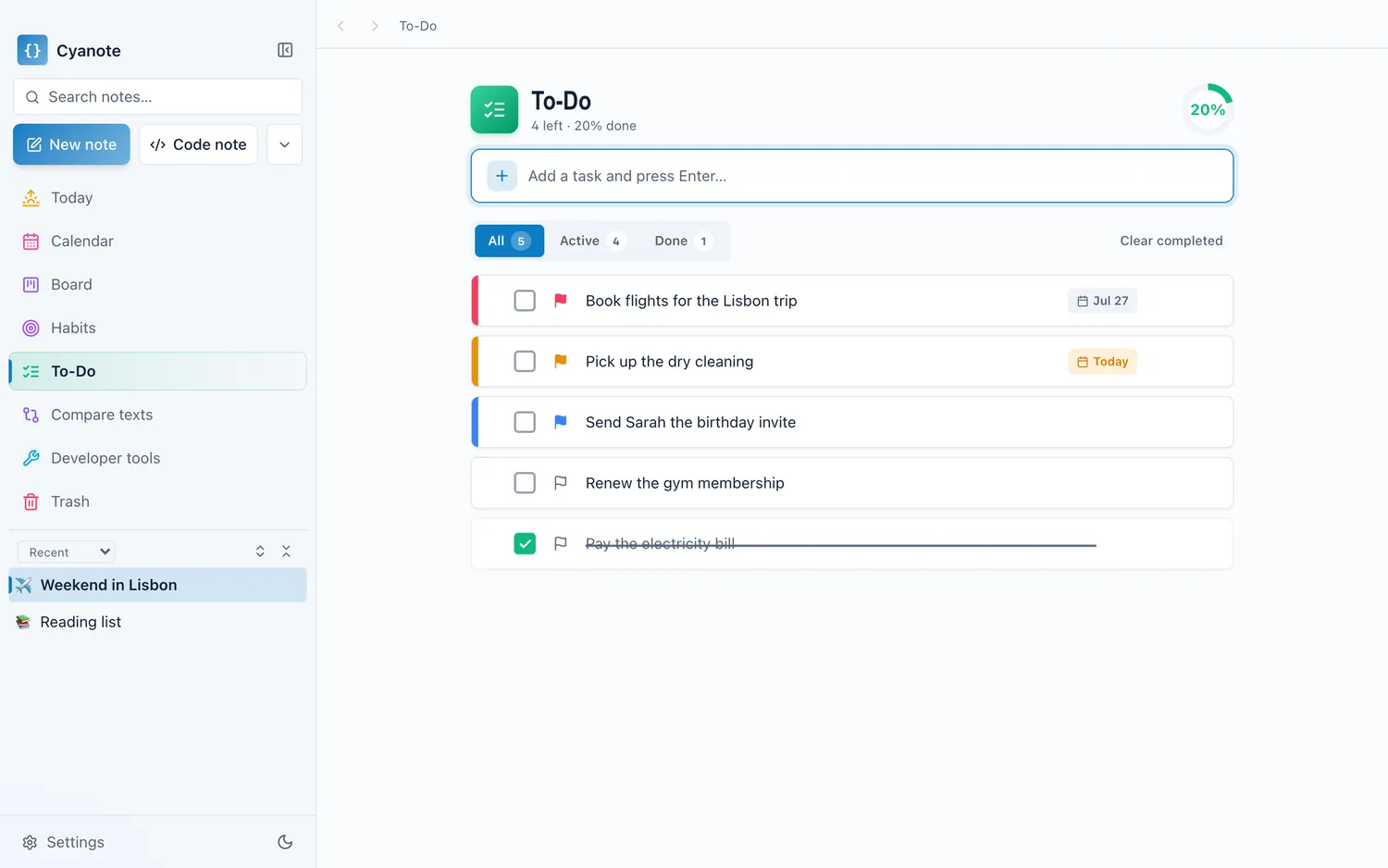
What is different is where they sit. To-dos with priorities, due dates, reminders and a Kanban board, in the same window as your notes, calendar, habits, routines and clipboard history, with no project cap, no filter cap and no account, in one file on your own computer, for $7.99 once.
Against $60 a year that is a fourteen-month payback on price alone, but price alone is the wrong reason to switch a task manager. The right reason is that the tasks and the notes about the tasks stop being in different applications. If you have never felt that friction, Todoist is the better product and you should keep it.
If you want a Mac task app you pay for once and Cyanote is not the right fit, I compared Things 3, OmniFocus 4, GoodTask and others in to-do list apps for Mac you can buy once.