In January 2025 I sat down to cancel one subscription and ended up cancelling five.
I had gone looking for a single charge I did not recognise. What I found instead was a small, quiet stack of them: Notion for notes, Todoist for tasks, Fantastical for the calendar, Streaks for habits, and Paste for the clipboard. None of them was expensive. Two were under five dollars a month. That is exactly why I had never looked at them together.
Added up, they came to roughly $260 a year. For software I had already decided I wanted, years ago, and had been re-buying every month since without ever making the decision again.
Written out, the stack was this:
| The job | What I was paying for it | What does it now |
|---|---|---|
| Writing things down | Notion | Notes, and code notes |
| What is due | Todoist | To-dos and a board |
| What is scheduled | Fantastical | Calendar |
| Daily habits | Streaks | Habits |
| What I copied earlier | Paste | Clipboard manager |
Five line items, about $260 a year between them, against $7.99 once. The money is the least interesting column, though. The next section is about the other one.
The bit that annoyed me was not the money
$260 is a real number but it is not a crisis. What actually bothered me was what I got for it.
A Tuesday looked like this. A thought arrives during a meeting, so it goes in Notion. It turns out to have a deadline, so a task goes in Todoist. The deadline is a Thursday, so I put a block in Fantastical. Later I want the meeting link I had copied twenty minutes earlier, so I open Paste. That evening Streaks asks whether I did the thing I said I would do daily, and I have no idea, because the evidence is spread across four other apps.
Five apps, five windows, five search boxes. Nothing was lost inside any one of them. Things were lost between them, in the seams, where the note about the project and the task for the project and the hour set aside for the project all existed, separately, and none of them knew about the others.
Every one of those apps was well made. Fantastical in particular is better at calendars than anything I have built or will build. That is the strange part. The failure was not in the software; it was in the shape of the arrangement. Five good apps do not add up to one good system, because the connective tissue is you, doing it by hand, several times a day, forever.
Two things I noticed about how they were priced
The first: I had never re-decided. A subscription is a decision you make once and then stop making. The bank makes it for you every month after that. I had chosen a habit tracker in 2022 based on what I needed in 2022, and I was still paying for that choice three years later, having never once asked whether it was still true.
The second is subtler, and it took me longer to see. When the money arrives monthly whether or not anything ships, the pressure on the software changes. It has to keep looking like it is worth the recurring charge. So features arrive — a team space, an AI assistant, an integrations directory, a web clipper — and the app gets bigger and slower and a little further from the thing you originally opened it for.
I do not think anyone is being cynical. It is just what the shape of the business rewards. But my notes app took four seconds to open a note, and I was paying every month for the privilege.
What I actually needed
So I wrote it down, honestly, rather than aspirationally. Not the features I might one day want, but the ones I had actually used in the previous month:
- somewhere to write things down that opened instantly
- a list of what is due, with dates and priorities
- a calendar showing what is due next to what is scheduled
- a light way to track a handful of daily habits
- clipboard history, because I copy things and then need them again ten minutes later
That is a modest list. It is nowhere near the union of what those five apps offered. It is close to the intersection of what I used.
The gap between those two things — everything the apps could do, and the small part I actually touched — is roughly the whole story of why productivity software feels heavy.
So I built it
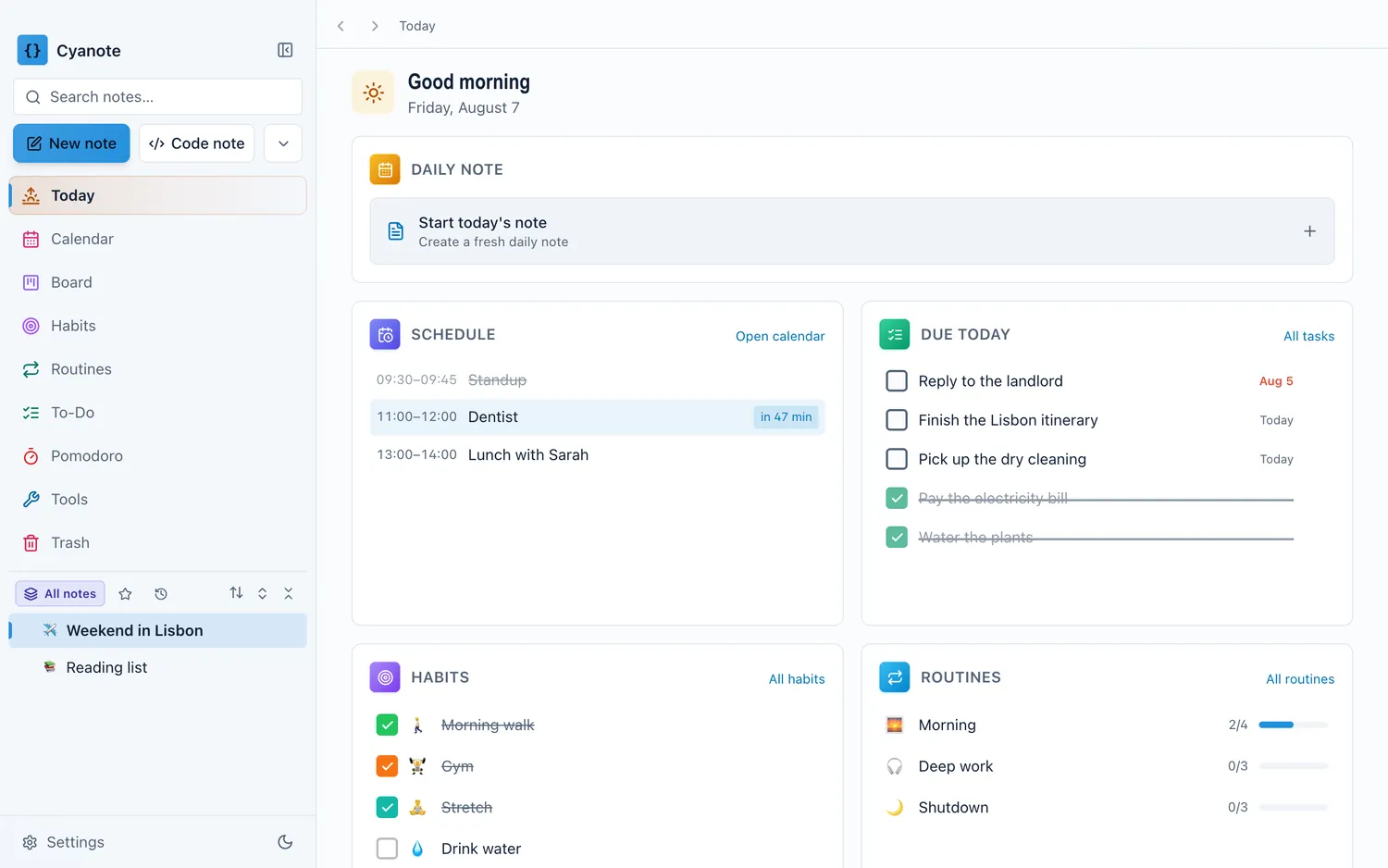
Cyanote is what came out. Notes, to-dos and a board, a calendar, habits, routines and a Pomodoro timer, and a system-wide clipboard manager, in one window, with one search box that looks across all of it.

The unification is not decorative. A task with a due date shows up in the calendar because it is the same task, not a copy synced across a boundary. A note can link to another note, and the note being linked to says so. When you finish a focus session against a task, the app can tell you later where the day actually went. None of that is clever engineering. It is just what stops being hard once the data is not living in five separate accounts.
It costs $7.99. Once. There is no subscription, no account and no upsell later. On the Mac, a new install asks once for the licence key from your purchase email; there is nothing to sign in to, and the key is not checked again after that. The changelog is the record of everything that has shipped since.
The honest economics of $7.99, once
I want to be straight about this, because "pay once" is often sold as pure virtue and it is really a trade.
What you get: no recurring charge, and an app with no structural reason to grow features you did not ask for. My income does not depend on this month looking busy. It depends on the app being good enough that someone recommends it. Those pressures point in a much better direction.
What I give up: predictable revenue. That means Cyanote will never have a large team, a support desk with shift rotas, or a five-year roadmap underwritten by investors. It is one person, shipping steadily. If you need enterprise SSO and a service-level agreement, this is honestly not the software for you, and I would rather say so on a blog post than in a refund email.
What you give up, specifically
There are three real costs and I would rather you know them now.
No sync between machines. Your data lives on your computer and stays there. Two computers means two separate sets of notes. This follows directly from the local-first design and I have written about the whole trade in what local-first actually means for your notes. It is a genuine cost, not a feature in disguise.
No mobile app. If capturing a thought on your phone at a bus stop is central to how you work, Cyanote covers the desk half of your life and something else covers the other half.
No collaboration. No shared documents, no comments, no team spaces. This is a tool for one person's own thinking.
Backups are yours. With no server, nobody is quietly keeping a copy for you. Cyanote exports everything to a single JSON file and your usual backup covers the rest, but the responsibility moved to your side of the line.
Was it worth it?
For me, obviously. I have been using it every day for a year and I no longer pay $260 for the privilege of copying things between windows.
The more useful answer is the general one. Most people do not need five productivity subscriptions. They need one place that opens fast, holds the week, and does not ask anything of them again. If that is you, the audit is worth doing even if you never install anything I made: open your bank statement, find every recurring software charge under ten dollars, and ask which ones you would buy again today.
You will cancel at least one. Possibly five.
If you want somewhere for it all to land afterwards, Cyanote is $7.99 and that is the last time it asks you for money. If you want to see the routine I use to keep a week from drifting, that is the weekly review, in 20 minutes.
Two of the five have pages of their own, weighed properly rather than in passing: Notion, which is free for one person and so is not really a money argument at all, and Paste, which is the better clipboard manager.