An insurance policy is a promise to replace things. A claim is the moment you find out the promise had conditions, and the main one is evidence.
Not evidence that the fire happened, or that the back door was forced — an assessor can see that. Evidence that you owned what you say you owned, and that it was worth what you say it was worth.
Almost nobody has it, and the reason is not carelessness. It is that the proof lives in the same room as the things.
What a claim actually asks for
The form is shorter than you expect and worse than you expect. It wants a list. One line per item, and for each one: what it was, the make and model, roughly when you bought it, and roughly what you paid.
Then, for anything expensive, it wants something behind the line. Policies differ and jurisdictions differ, so read your own, but the shape is consistent: below a certain per-item value the insurer will generally take your word, and above it they will ask for a receipt, a bank or card statement showing the purchase, a photograph of the item in your home, a serial number, or a valuation.
Sitting down to write that list from memory, three days after something bad happened, is the worst possible time to do it. You will forget entire categories. People routinely remember the television and forget the six years of tools in the shed, the two bicycles, the good coat, the external drive, the wedding rings that were in the drawer rather than on a hand.
The list you write from memory is not the list of what you lost. It is the list of what you can still picture.
The list has to survive the event it documents
This is the part that makes a home inventory different from ordinary admin, and it is the part most advice skips.
An inventory kept in a note on the laptop is useless after the laptop is stolen. A spreadsheet on the iMac is useless after the flat floods. A folder of photographs on the phone is useless if the phone went with the bag. The document exists specifically for a category of event that is quite likely to take the document with it.
So there are really two jobs, and doing the first without the second is close to worthless:
- Write the inventory.
- Put a copy somewhere the disaster cannot reach.
The second one is not complicated. Export the note, or print it to PDF, and keep that file in at least one place that is not your home and not the machine it was written on — an external drive kept at work or at a relative's, a printed copy in a folder somewhere else, an encrypted archive in whatever cloud storage you already pay for. The three copies, two places rule exists for exactly this, and an inventory is the one document where people most often skip it.
If you take nothing else from this, take that. A perfect inventory in one location is a worse plan than a rough inventory in three.
What one entry needs
You are not writing a catalogue. You are writing the minimum that lets a stranger agree with you about something that no longer exists.
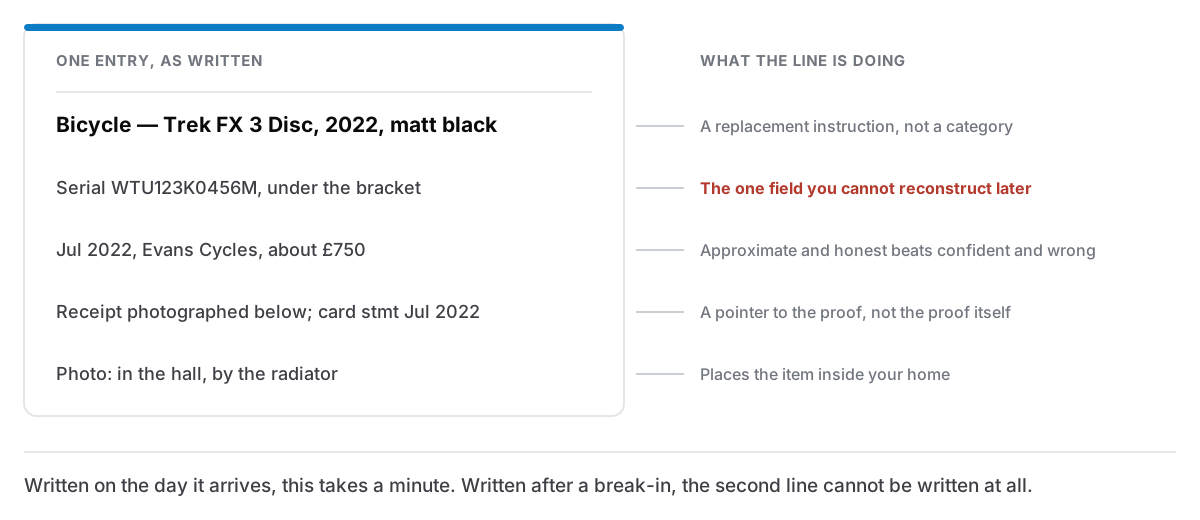
Five lines, and the discipline is to keep them to five. The entry that takes four minutes to write is the entry you stop writing on item nine.
What it is. Make and model, not "laptop". "MacBook Pro 14-inch, M3 Pro, space black" is a replacement instruction. "Laptop" is a negotiation.
Serial or identifying number. More on this below — it is the one field that does real work.
When and where you bought it, and what you paid. Approximate is fine and honest. "About March 2023, John Lewis, around £1,400" is far better than nothing and far better than a confident wrong number.
Where the proof is. Not the proof itself — a pointer. "Receipt photographed below", or "card statement, Barclays, March 2023", or "order in the Apple account". Half of a claim is knowing where to go looking.
A photograph. The item, in your home, with enough of the room in the frame to place it there.
Serial numbers are the field that earns its keep
Every other field on that list can be reconstructed after the fact, with effort. You can trawl old bank statements for the price. You can find the model from an old email. You can approximate the date.
You cannot reconstruct a serial number, because the only place it was written was on the object, and the object is gone.
A serial number turns "a bicycle" into "that bicycle". It is what makes a police report specific, what a pawnbroker or a marketplace listing can be checked against, what makes a recovered item provably yours, and what removes any argument with an assessor about which model you actually had.
It is also printed somewhere inconvenient on almost everything you own: the underside of the laptop, the back of the television, the frame under the bottom bracket, the inside of the appliance door, the plate behind the boiler casing. Twenty minutes with a phone camera, walking round the flat photographing the small print, is the single highest-value thing in this entire article. Photographs paste straight into a note, so the picture of the plate can sit in the entry for the thing it belongs to, which is the only place you will ever think to look for it.
You do not need to list everything
The reason most inventories are never finished is that people start in the kitchen, itemise cutlery, and give up before the bedroom.
Itemise four things:
- anything worth more than roughly a hundred of your local currency unit
- anything with a serial number
- anything irreplaceable, which usually means jewellery, instruments, tools and anything inherited
- anything specifically listed or excluded on your policy, because those are the items the insurer has already told you it will argue about
Everything else — clothes, books, kitchenware, the contents of the cupboard under the stairs — gets handled in one pass, with video. Walk through the home with a phone, open every cupboard and wardrobe, and narrate as you go. It takes fifteen minutes and produces something no list can: evidence that a room full of ordinary possessions existed. Nobody itemises forty books. A thirty-second pan of the shelves settles it.
Save the video with the inventory, and copy it off the machine along with everything else.
If you rent, that same walkthrough is doing two jobs at once. Shot on the day you get the keys it is also the evidence that decides your deposit, which is a separate argument with a separate opponent and the same photographs.
Receipts rot
Two quiet failures, both common.
Till receipts fade. Thermal paper goes blank, and the timescale is years, not decades — a drawer of receipts kept since 2019 may already be a drawer of grey rectangles. The fix is to photograph them once, when they are new, and throw the paper away with a clear conscience.
Email receipts leave with the account. An order confirmation in a webmail account you no longer use, or a purchase history inside a retailer's account you have since closed, is evidence held by somebody else on terms you do not control. If it matters, it belongs in a file you hold. This is the same argument as getting your notes out, applied to shopping.
Keeping it true
An inventory decays faster than almost any other document, because you keep buying things. A list written two years ago and never touched is not merely incomplete — it is misleading, because it looks authoritative and describes a home you no longer have.
Two habits keep it honest, and neither is a project.
Add at the point of purchase. When something expensive arrives, the entry takes sixty seconds, because everything you need is in your hand: the box with the serial, the confirmation email, the price you just paid. The same entry costs twenty minutes in eighteen months, which is why it never gets written then.
Read it once a year. Attach it to something that already happens annually — the renewal date on the policy is the natural hook, since you are thinking about cover anyway. If the renewal is already in your calendar with a month's notice, add the inventory review to the same reminder.
While you are there, the review answers the more useful question: is the cover still right? An inventory that adds up to substantially more than your contents sum is the cheapest possible warning that you are underinsured, and you would not otherwise discover it until the day it matters.
Where it should live
An itemised list of everything valuable in your home, with photographs and purchase dates, is not an ordinary document. It is a shopping list for a burglar and a gift to anyone who breaches a service you uploaded it to.
That is the argument for keeping it somewhere with no account attached. A note on your own Mac cannot be locked out from the other end, cannot be read by a support engineer, works when the broadband is off, and is not sitting in a service whose breach notification you will read in two years. It is what local-first actually buys you, on a document where the stakes are unusually legible.
The trade is that the responsibility for copies moves entirely to you — which is where this article started, and why the off-site copy is not optional. There is no server quietly keeping a second version of this one.
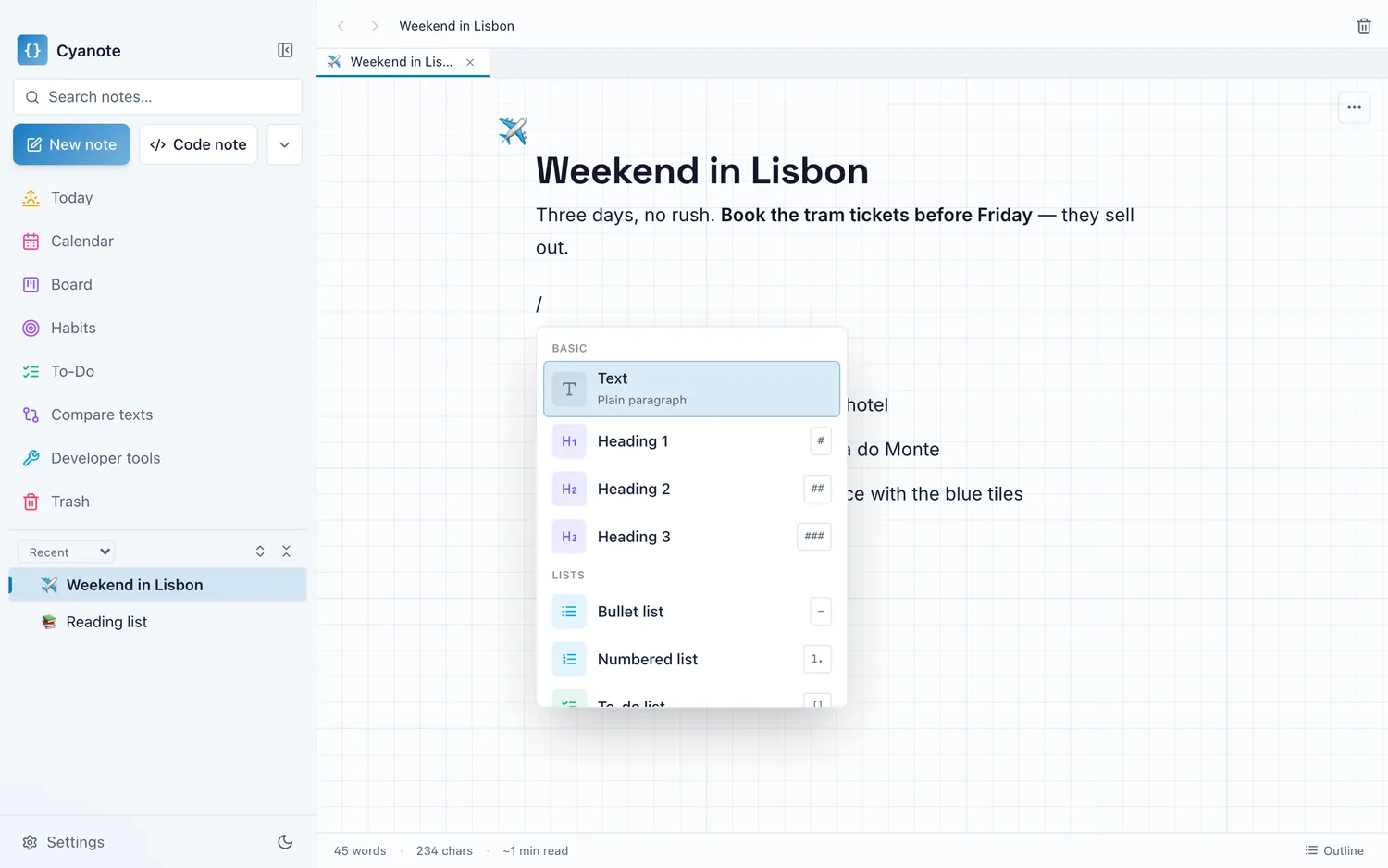
Whether it is one note per room, one per category, or a single long note, matters much less than people think. Search finds the item either way. Pick the one you will finish.
The honest version
This is admin with a bad payoff profile. Most people will do it and never need it, which makes it feel like wasted effort right up until the week it is worth several thousand pounds and a great deal of arguing.
And there is a second beneficiary who is easy to forget. If someone else ever has to deal with your home — an executor, a partner, whoever is left sorting out what you had — this list is the difference between a week of work and a month of guessing.
Start with the twenty-minute version. Walk round with a phone, photograph the serial plates and the receipts you still have, shoot the video, and write entries for the ten most expensive things you own. That is most of the value, and it fits in an evening.
Then copy it somewhere else. That part is the article.
If you want somewhere to keep it that has no account to lose, works offline and holds the photographs next to the list, Cyanote is $7.99, once. It exports the lot to a single file, which is exactly the file you want to put somewhere that is not your house.